Question
What is the difference between the terms orbit and orbital?

Answer

 
Orbit
 
Orbital
i.
An orbit is a well-defined circular path around the nucleus in which the electrons revolve.
i.
An orbital is the three-dimensional space around the nucleus within which the probability of finding an electron is maximum (upto 90%)
ii.
It represents the planar motion of an electron around the nucleus.
ii.
It represents the three dimensional motion of an electron around the nucleus.
iii.
All orbits are circular and disc like.
iii.
Different orbitals have different shapes, i.e. s-irbitals are spherically symmetrical, p-orbitals are dumb-bell shaped and so on.

Need a full question paper?

Generate a complete, print-ready paper with questions like this in minutes — across 16+ boards, with answer keys.
Start Generating Free

Similar questions

Why is $\mathrm{Li}_2 \mathrm{CO}_3$ decomposed at a lower temperature whereas $\mathrm{Na}_2 \mathrm{CO}_3$ at higher temperature?
  1. Draw cis and trans-structures for Hex-2-ene. Which isomer will have higher boiling point and why?
  2.  
Why is LiF almost insoluble in water whereas LiCl soluble not only in water but also in acetone?
1. At $298 K, K _{ p }$ for the reaction $N _2 O _4(g) \rightleftharpoons 2 NO _2(g)$ is 0.98 . Predict whether the reaction is spontaneous or not.
2. Define specific heat.
3. State Hess's law.
An evacuated vessel weights 50 g when empty, 144 g when filled with liquid of density $0.47 \mathrm{~g} \mathrm{~mL}^{-1}$ and 50.5 g when filled with ideal gas at 760 mm Hg and 300 K . Calculate molar mass of ideal gas. $\left[R=0.08212\right.$ atom $\left.\mathrm{K}^{-1} \mathrm{~mol}^{-1}\right]$
Justify that the following reactions are redox reactions:
i. $CuO + H _2(g) \longrightarrow Cu ( s )+ H _2 O$ (g)
ii. $Fe _2 O _3$ (s) $+3 CO ( g ) \longrightarrow 2 Fe ( s )+3 CO _2$ (g)
iii. $4 BCl _3(g)+3 LiAlH _4(s) \longrightarrow 2 B_2 H _6(g)+3 LiCl ( s )+3 AlCl _3(s)$
Identify the type of reactions:
  1. $\text{CH}_4+\text{Cl}_2\xrightarrow{\text{sunlight}}\text{CH}_3\text{Cl}+\text{HCl}$
  2. $\text{C}_6\text{H}_6+(\text{conc.})\text{HNO}_36\xrightarrow{\text{conc.}\text{H}_2\text{SO}_4}\text{C}_6\text{H}_5\text{NO}_2+\text{H}_2\text{O}$
  3. $ \ \ \ \ \ \ \ \ \ \ \ \ \ \ \ \ \ \ \ \ \ \ \ \ \ \ \ \ \ \ \ \ \ \ \ \ \ \ \ \ \ \ \ \ \ \ \ \ \ \ \ \ \ \ \ \ \ \ \ \ \ \ \ \ \ \text{Br}\\\ \ \ \ \ \ \ \ \ \ \ \ \ \ \ \ \ \ \ \ \ \ \ \ \ \ \ \ \ \ \ \ \ \ \ \ \ \ \ \ \ \ \ \ \ \ \ \ \ \ \ \ \ \ \ \ \ \ \ \ \ \ \ \ \ \ |\\\text{CH}_3-\text{CH}=\text{CH}_2+\text{HBr}\xrightarrow{\ \ \ \ \ \ \ }\text{CH}_3-\text{CH}-\text{CH}_3$
  4. $\ \ \ \ \ \ \ \ \ \ \ \ \ \text{O}\ \ \ \ \ \ \ \ \ \ \ \ \ \ \ \ \ \ \ \ \ \ \ \ \ \ \ \ \ \ \ \ \ \ \ \ \ \ \ \ \ \ \ \ \ \ \ \text{OH}\\\ \ \ \ \ \ \ \ \ \ \ \ \ \| \ \ \ \ \ \ \ \ \ \ \ \ \ \ \ \ \ \ \ \ \ \ \ \ \ \ \ \ \ \ \ \ \ \ \ \ \ \ \ \ \ \ \ \ \ \ \ \ \ \ |\\ \text{CH}_3-\text{C}-\text{CH}_3+\text{HCN}\xrightarrow{\ \ \ \ \ \ \ \ }\text{CH}_3-\text{C}-\text{CH}_3\\\ \ \ \ \ \ \ \ \ \ \ \ \ \ \ \ \ \ \ \ \ \ \ \ \ \ \ \ \ \ \ \ \ \ \ \ \ \ \ \ \ \ \ \ \ \ \ \ \ \ \ \ \ \ \ \ \ \ \ \ \ \ \ \ \ |\\\ \ \ \ \ \ \ \ \ \ \ \ \ \ \ \ \ \ \ \ \ \ \ \ \ \ \ \ \ \ \ \ \ \ \ \ \ \ \ \ \ \ \ \ \ \ \ \ \ \ \ \ \ \ \ \ \ \ \ \ \ \ \ \ \text{CN}$
  5. $\text{CH}_3-\text{CH}=\text{CH}_2\xrightarrow[\text{peroxide}]{\text{HBr}}\text{CH}_3\text{CH}_2\text{CH}_2\text{Br}$
  6. $\text{CH}_3\text{Cl}+\text{KOH}(\text{aq})\xrightarrow{\ \ \ \ \ \ \ \ \ }\text{CH}_3\text{OH}+\text{KCl}$

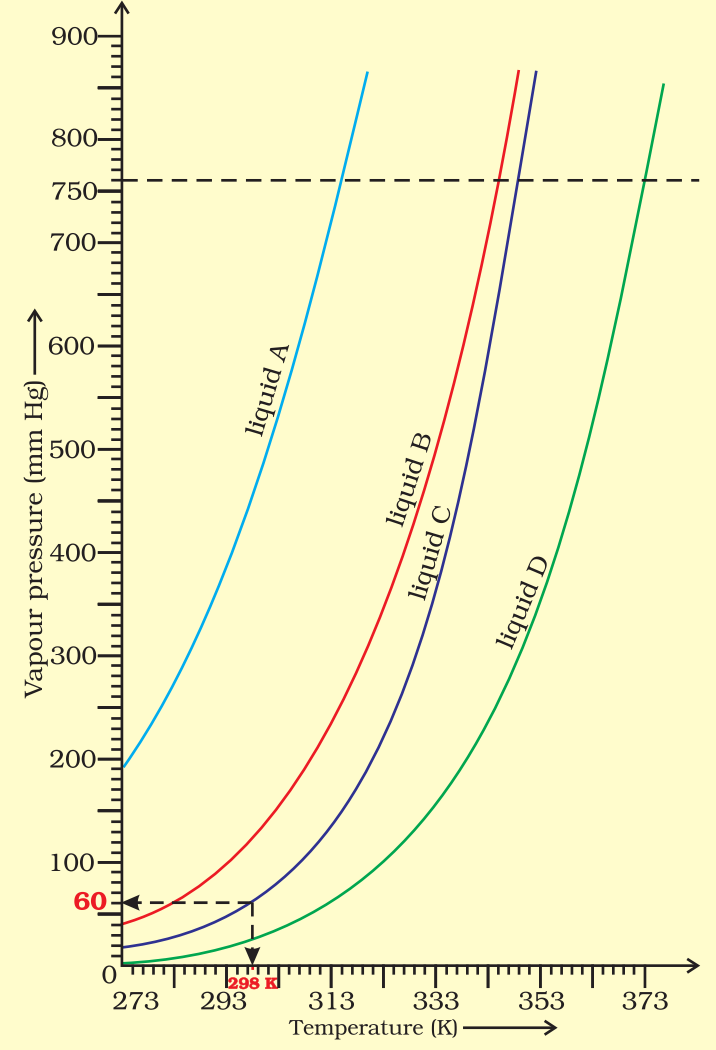
The variation of vapour pressure of different liquids with temperature is shown in Fig.
  1. Calculate graphically boiling points of liquids A and B.
  2. If we take liquid C in a closed vessel and heat it continuously. At what temperature will it boil?
  3. At high altitude, atmospheric pressure is low (say 60 mm Hg). At what temperature liquid D boils?
  4. Pressure cooker is used for cooking food at hill station. Explain in terms of vapour pressure why is it so?
1. Calculate the gram molecular mass of sugar having molecular formula $C _{12} H _{22} O _{11}$.
2. Calculate
a. The mass of 0.5 g molecule of sugar and
b. Gram molecule of sugar in 547.2 g .
One mole of any substance contains $6.022 \times 10^{22}$ atoms/ molecules. Calculate the number of molecules of $\mathrm{H}_2 \mathrm{SO}_4$ present in 100 mL of $0.02 \mathrm{M} \mathrm{~H}_2 \mathrm{SO}_4$ Solution.