MCQ
What is the distance between $(1, 3)$ and $(5, 6)?$
  • A
    $3$ units.
  • B
    $4$ units.
  • $5$ units.
  • D
    $25$ units.

Answer

Correct option: C.
$5$ units.
We know, distance between two points $(x_1, y_1)$ and $(x_2, y_2)$ is $\sqrt{(\text{x}_{1}-\text{x}_{2}) ^{2}+{(\text{y}_{1}-\text{y}_{2})} ^{2}}$
So, distance between $(1, 3)$ and $(5, 6)$ is
$\sqrt{{(1-5)}^{2}+(3-6)^{2}}$
$= \sqrt{{(4)}^{2}+(3)^{2}}$
$= 5\text{ units}.$

Need a full question paper?

Generate a complete, print-ready paper with questions like this in minutes — across 16+ boards, with answer keys.
Start Generating Free

Similar questions

Let $\ell$ be a line which is normal to the curve $y=2 x^{2}+x+2$ at a point $P$ on the curve. If the point $Q(6,4)$ lies on the line $\ell$ and $O$ is origin, then the area of the triangle $OPQ$ is equal to.......
Which of the following statements is false:
For $0 < \phi < \frac{\pi }{2},$ if $x = \sum\limits_{n = 0}^\infty {{{\cos }^{2n}}\phi ,} $ $y = \sum\limits_{n = 0}^\infty {{{\sin }^{2n}}\phi ,} $ $z = \sum\limits_{n = 0}^\infty {{{\cos }^{2n}}\phi \,{{\sin }^{2n}}\phi ,} $ then
A normal chord of the parabola $ y^2 = 4x$  subtending a right angle at the vertex makes an acute angle $ \theta $ with the $x-$ axis, then $\theta$  equals to
Two dice are thrown simultaneously. The probability of obtaining a total score of 5 is:
The first term of a $G.P.$ is $7$, the last term is $448$ and sum of all terms is $889$, then the common ratio is
How many numbers between $5000$ and $10,000$ can be formed using the digits $1, 2, 3, 4, 5, 6, 7, 8, 9$ each digit appearing not more than once in each number
The equation of the ellipse with focus $(-1, 1),$ directrix $x - y + 3 = 0$ and eccentricity $\frac{1}{2}$ is:
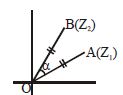
Let $z_1$, $z_2$ are the two complex number and roots of the equation $z^2 + az + b = 0$ and $O$ is the origin, such that $OA = OB$ and ${a^2} = \lambda b{\ \cos ^2}\ \frac{\alpha }{2}$, then $\lambda$ is equal to
The number of natural number $n$ in the interval $[1005, 2010]$ for which the polynomial. $1+x+x^2+x^3+\ldots+x^{n-1}$ divides the polynomial $1+x^2+x^4+x^6+\ldots+x^{2010}$ is