Question
What is the fractional error in $g$ calculated from $T = 2\pi \sqrt {l/g} $ ? Given fraction errors in $T$ and $l$ are $ \pm x$ and $ \pm y$ respectively?

Answer

From $T = 2\pi \sqrt {\frac{\ell }{g};} \,g = 4{\pi ^2}\frac{\ell }{{{T^2}}}$
$\frac{{\Delta g}}{g} = \frac{{\Delta \ell }}{\ell } + \frac{{2\Delta T}}{T} = \left( {y + 2x} \right)$

Need a full question paper?

Generate a complete, print-ready paper with questions like this in minutes — across 16+ boards, with answer keys.

Start Generating Free

Similar questions

In an $ac$ circuit, the current lags behind the voltage by $\pi /3$. The components in the circuit are    
A projectile is thrown at an angle $\theta$ with the horizontal and its range is $R_1$. It is then thrown at an angle $\theta$ with vertical and the range is $R_2$, then
When the $P$ end of $P-N$ junction is connected to the negative terminal of the battery and the $N$ end to the positive terminal of the battery, then the $P-N$ junction behaves like
The first resonance length of a resonance tube is $40\,\, cm$ and the second resonance length is $122\,\, cm$. The third resonance length of the tube will be... $cm$
Light from the constellation Virgo is observed to increase in wavelength by $0.4$. With respect to Earth the constellation is
The graph between the square root of the frequency of a specific line of characteristic spectrum of $X-$ rays and the atomic number of the target will be
The period of oscillation of a simple pendulum in the experiment is recorded as $2.63\, s, 2.56 s, 2.42\, s, 2.71\, s$ and $2.80 \,s$ respectively. The average absolute error is ......... $s$
In $NPN$ transistor, if doping in base region is increased then collector current
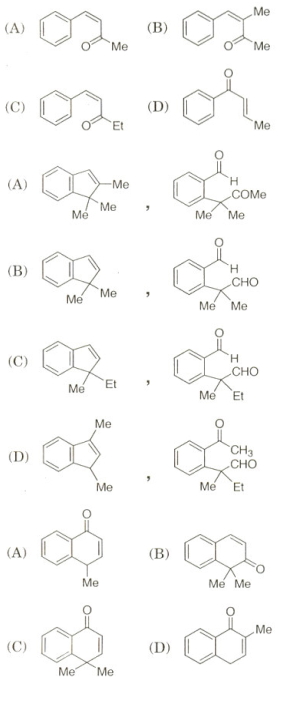
A carbonyl compound ${P}$, which gives positive iodoform test, undergoes reaction with $\mathrm{MeMgBr}$ followed by dehydration to give an olefin ${Q}$. Ozonolysis of ${Q}$ leads to a dicarbonyl compound ${R}$, which undergoes intramolecular aldol reaction to give predominantly ${S}$.

${P} \xrightarrow[\substack{\text { 2. } \mathrm{H}^{+}, \mathrm{H}_2 \mathrm{O} \\ \text { 3. } \mathrm{H}_2 \mathrm{SO}_4, \Delta}]{\text { 1. MeMgBr }}Q \xrightarrow[\text { 2. } \mathrm{Zn}, \mathrm{H}_2 \mathrm{O}]{1 . \mathrm{O}_3} {R} \xrightarrow[\text { 2. } \Delta]{1 . \mathrm{OH}^{-}} {S}$

$1.$ The structure of the carbonyl compound ${P}$ is

$Image$

$2.$ The structures of the products ${Q}$ and ${R}$, respectively, are

$Image$

$3.$ The structure of the product ${S}$ is

$Image$

Give hte answer question $1,2$ and $3.$
$_{90}^{232}Th$ an isotope of thorium decays in ten stages emitting six  $\alpha$-particles and four $\beta$-particles in all. The end product of the decay is