Question
What is the effective capacitance between points X and Y

|
(a) 24 μF |
(b) 18 μF |
(c) 12 μF |
(d) 6 μF |
What is the effective capacitance between points X and Y
|
(a) 24 μF |
(b) 18 μF |
(c) 12 μF |
(d) 6 μF |
(d) 6 μF
Generate a complete, print-ready paper with questions like this in minutes — across 16+ boards, with answer keys.
A cube of side l is placed in a uniform field E, where E = E . The net electric flux through the cube is
|
(a) Zero |
(b) |
(c) 4 |
(d) 6 |
In an interference arrangement similar to Young's double slit experiment, the slits S1 and S2 are illuminated with coherent microwave sources each of frequency 106 Hz. The sources are synchronized to have zero phase difference. The slits are separated by distance d = 150 m. The intensity I (𝜃) is measured as a function of q, where q is defined as shown. If I0 is maximum intensity, then I(θ) for 0 ≤ θ ≤ 90° is given by

|
(a) I(θ) = |
(b) I(θ) = |
|
(c) I(θ) = |
(d) a, b |
Field inside a solenoid is
|
(a) Directly proportional to its length |
|
(b) Directly proportional to current |
|
(c) Inversely proportional to total number of turns |
|
(d) Inversely proportional to current |
The graph gives the magnitude B(t) of a uniform magnetic field that exists throughout a conducting loop, perpendicular to the plane of the loop. Rank the five regions of the graph according to the magnitude of the emf induced in the loop, greatest first
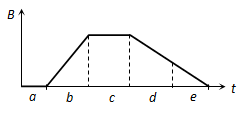
|
(a) b > (d = e) < (a = c) |
(b) b > (d = e) > (a = c) |
|
(c) b < d < e < c < a |
(d) b > (a = c) > (d = e) |


