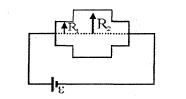
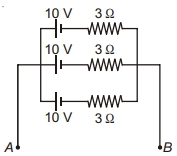
What is the equivalent resistance of the circuit ............. $\Omega$
Medium


Download our appand get started for free
Experience the future of education. Simply download our apps or reach out to us for more information. Let's shape the future of learning together!No signup needed.*
Similar Questions
- 1A Daniel cell is balanced on $125\,cm$ length of a potentiometer wire. Now the cell is short-circuited by a resistance $2\, ohm$ and the balance is obtained at $100\,cm$. The internal resistance of the Daniel cell is .............. $ohm$View Solution
- 2The resistivity of iron is$1 \times {10^{ - 7}}\,ohm - m$. The resistance of a iron wire of particular length and thickness is $1\, ohm$. If the length and the diameter of wire both are doubled, then the resistivity in $ohm - m$ will beView Solution
- 3Two electric bulbs whose resistances are in the ratio of $1 : 2$ are connected in parallel to a constant voltage source. The powers dissipated in them have the ratioView Solution
- 4When $5\ V$ potential difference is applied across a wire of length $0.1\ m$, the drift speed of electrons is $2.5 \times 10^{-4}$ $ms^{-1}$ . If the electron density in the wire is $8 \times 10^{28}$ $m^{-3}$ the resistivity of the material is close toView Solution
- 5$n$ identical cells are joined in series with two cells $A$ and $B$ with reversed polarities. $emf$ of each cell is $E$ and internal resistance is $r$. Potential difference across cell $A$ and $B$ is : $(n > 4)$View Solution
- 6View SolutionTwo wires of the same material are given. The first wire is twice as long as the second and has twice the diameter of the second. The resistance of the first will be
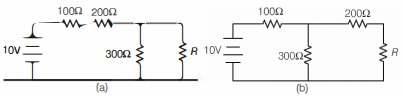
- 7A student was trying to construct the circuit shown in the figure below marked $(a)$, but ended up constructing the circuit marked $(b)$. Realising her mistake, she corrected the circuit, but to her surprise, the output voltage (across $R$ ) did not change. The value of resistance $R$ is ............ $\Omega$View Solution
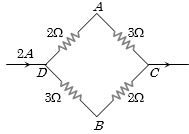
- 8A current of $2\,A$ flows in a system of conductors as shown. The potential difference $({V_A} - {V_B})$ will be ............ $V$View Solution
- 9Three identical cells are connected in parallel across $A B$. Net emf across $A B$ is .......... $V$View Solution
- 10A cylindrical resistance is connected across battery $\varepsilon $ . Cylinder has uniform free electron density, mid part of cylinder has larger radius as shown in figure. Then $V_d$ (drift velocity) $V/S$ (distance across the length of the resistance)View Solution