Question
What is the impact parameter? Explain the trajectory of $\alpha$-particle from it.

Answer

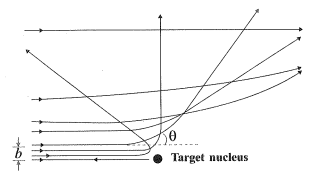
→Impact parameter (b) : "The perpendicular distance of the initial velocity vector of the $\alpha$-particle from the centre of the nucleus is called the impact parameter."
The path (trajectory) of an $\alpha$-particle depends on impact parameter of the collision with the nucleus.
Image
As shown in the figure, the impact parameters (b) of $\alpha$-particles are different so that they scattered in various directions with different probabilities.
An $\alpha$-particle which is close to the nucleus suffers large scattering.
In case of head-on collision, the impact parameter is minimum and the $\alpha$-particle rebounds back. (For head-on collision $b \approx 0, \theta \approx 180^{\circ}$ )
For a large impact parameter, the $\alpha$-particle goes nearly undeviated and has a small deflection.
The fact that only a small fraction of the number of incident particles of the number of incident particles rebound back indicates that the number of $\alpha$-particles undergoing head on collision is small. This implies that the mass and positive charge of the atom is concentrated in a small volume.
Therefore, Rutherford scattering experiment is a powerful way to determine the size of the nucleus.

Need a full question paper?

Generate a complete, print-ready paper with questions like this in minutes — across 16+ boards, with answer keys.
Start Generating Free

Similar questions

Write the expression for Lorentz magnetic force on a particle of charge 'q' moving with velocity$\overrightarrow{\text{v}}$ in a magnetic field $\overrightarrow{\text{B}}.$ Show that no work is done by this force on the charged particle.
A square surface of side L meter is kept in the plane of the paper. A uniform elecrtric field $\overrightarrow{ E }$ is also present in the plane of the paper and it is limited to the lower half of the page as shown in the figure. What will be the electric flux bound to the surface?Image
(a) An em wave is travelling in a medium with a velocity $\vec{v}=v\hat{i}$. Draw a sketch showing the propagation of the em wave, indicating the direction of oscillating electric and magnetic fields. (b) How are the magnitudes of the electric and magnetic fields related to the velocity of em wave.
A point source is placed at a depth h below the surface of water (refractive index = μ).
  1. Show that light escapes through a circular area on the water surface with its centre directly above the point source.
  2. Find the angle subtended by a radius of the area on the source.
The quantities of charge on the two conducting spheres of radius $4 \ cm$ and $7 \ cm$ are $50$0 micro coulombs and $60$ micro coulombs respectively. Calculate the loss in electrical potential energy when conductors are joined together.
Identify the electromagnetic waves whose wavelengths lie in the range$:$
  1. $10^{–11} m < \lambda < 10^{–14} m$
  2. $10^{–4} m < \lambda < 10^{–6} m$
Write one use for each.
An electric dipole is placed inside a closed surface, whose dipole moment is $20 \times 10^{-6}$ coulomb-meter. What will be the electric flux emerging out of this surface?
The pressures of the gas in a constant volume gas thermometer are 80cm, 90cm and 100cm of mercury at the ice point, the steam point and in a heated wax bath, respectively. Find the temperature of the wax bath.
Plot a graph showing the variation of stopping potential with the frequency of incident radiation for two different photosensitive materials having work functions $W_1$ and $W_2 \ (W_1 > W_2).$ On what factors does the $(i)$ slope and $(ii)$ intercept of the lines depend?
Explain the relationship between mass and energy from Einstein's theory of special relativity.