Question
What is the impact parameter? Explain the trajectory of $\alpha$-particle from it.
Answer

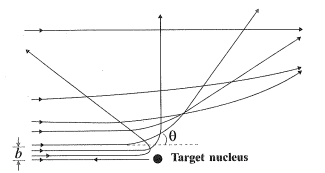
→Impact parameter (b) : "The perpendicular distance of the initial velocity vector of the $\alpha$-particle from the centre of the nucleus is called the impact parameter."
The path (trajectory) of an $\alpha$-particle depends on impact parameter of the collision with the nucleus.
Image
As shown in the figure, the impact parameters (b) of $\alpha$-particles are different so that they scattered in various directions with different probabilities.
An $\alpha$-particle which is close to the nucleus suffers large scattering.
In case of head-on collision, the impact parameter is minimum and the $\alpha$-particle rebounds back. (For head-on collision $b \approx 0, \theta \approx 180^{\circ}$ )
For a large impact parameter, the $\alpha$-particle goes nearly undeviated and has a small deflection.
The fact that only a small fraction of the number of incident particles of the number of incident particles rebound back indicates that the number of $\alpha$-particles undergoing head on collision is small. This implies that the mass and positive charge of the atom is concentrated in a small volume.
Therefore, Rutherford scattering experiment is a powerful way to determine the size of the nucleus.

Need a full question paper?

Generate a complete, print-ready paper with questions like this in minutes — across 16+ boards, with answer keys.

Start Generating Free

Similar questions

What conclusion can you draw from the following observations on a resistor made of alloy manganin?
Current A
Voltage V
Current A
Voltage V
0.2 
0.4
0.6
0.8
1.0
2.0
3.94
7.87
11.8
15.7
19.7
39.4
3.0
4.0
5.0
6.0
7.0
8.0
59.2
78.8
98.6
118.5
138.2
158.0
A steel wire and a copper wire of equal length and equal cross-sectional area are joined end to end and the combination is subjected to a tension. Find the ratio of.
  1. The stresses developed in the two wires.
  2. The strains developed. Y of steel = 2 × 10¹¹N/m2. Y of copper =  1.3 × 10¹¹N/m2.
When are two objects just resolved? Explain. How can the resolving power of a compound microscope be increased? Use relevant formula to support your answer.
A non-ideal battery is connected to a resistor. Is work done by the battery equal to the thermal energy developed in the resistor? Will your answer change if the battery is ideal?
Assume that each iron atom has a permanent magnetic moment equal to 2 Bohr magnetons (1 bohr magneton equals 9.27 × 10⁻²⁴A-m2). The density of atoms in iron is 8.52 × 1028 atoms/m3.
  1. Find the maximum magnetization I in a long cylinder of iron.
  2. Find the maximum magnetic field B on the axis inside the cylinder.
The average kinetic energy of molecules in a gas at temperature T is 1.5kT. Find the temperature at which the average kinetic energy of the molecules of hydrogen equals the binding energy of its atoms. Will hydrogen remain in molecular from at this temperature? Take k = 8.62 × 10⁻⁵eVK-1.
Is neutral temperature always the arithmetic mean of inversion temperature and the temperature of the cold junction? Does the unit of temperature have an effect in deciding this question?
Find the moment of inertia of a pair of spheres, each having a mass m and radius r, kept in contact about the tangent passing through the point of contact.
An optical fibre $(\mu=1.72)$ is surrounded by a glass coating $(\mu=1.50).$ Find the critical angle for total internal/ reflection at the fibre-glass interface.
A long straight wire carrying a current of 30 A is placed in an external uniform magnetic field of $4.0 \times 10^{-4} T$ parallel to the current. Find the magnitude of the resultant magnetic field at a point 2.0 cm away from the wire.