Question
What is the magnetic effect of electric current?

Answer

An electric current produces a magnetic field around it. This phenomenon is known as the magnetic effect of electric current. It was discovered by Hans Christian Oersted.
It was Ampere who first speculated that all magnetic effects are attributable to electric charges in motion (electric current). It takes a moving electric charge to produce a magnetic field, and it takes another moving electric charge to “feel” a magnetic field.
[Note : Hans Christian Oersted (1777-1851), Danish physicist, discovered electromagnetism in 1820. The oersted, the CGS unit of magnetic field strength, is named after him.]
Need a full question paper?

Generate a complete, print-ready paper with questions like this in minutes — across 16+ boards, with answer keys.

Start Generating Free

Similar questions

What is magnetization, magnetic intensity and magnetic susceptibility?
A thin uniform rod $1 \mathrm{~m}$ long has mass $1 \mathrm{~kg}$. Find its moment of inertia and radius of gyration for rotation about a transverse axis through a point midway between its centre and one end.
The radii of two columns of a $U$-tube are $r_1$ and $r_2$. When a liquid of density $\rho$ and angle of contact $\theta=0^{\circ}$ is filled in it, the level difference of the liquid in the two columns is $h$. Find the surface tension of the liquid.
An electron is accelerated from rest through $86 V$ and then enters a region of uniform magnetic induction of magnitude $1.5 T$. What is the maximum value of the magnetic force the electron can experience?
$\left[ m _{ e }=9.11 \times 10^{-31} \ kg , e =1.6 \times 10^{-19} C \right]$
The total impedance of a circuit decreases when a capacitor is added in series with L and R. Explain why ?
Show that the root means the square speed of the molecules of a gas is directly proportional to the square root of the absolute temperature of the gas.
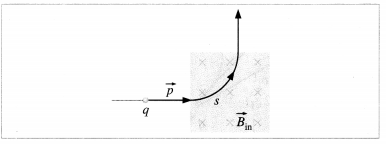
A particle of charge q and momentum p enters a region of uniform magnetic field B travelling at right angles to the field, and is deflected through a right angle as shown. Obtain an expression for the length of the particle’s path In terms of q, p and B.
Image
Derive an expression for the kinetic energy of a rotating body with uniform angular velocity.
What is photoelectric effect? Define: (i) Stopping potential, (ii) Photoelectric work function.
Explain the reflection of light at a plane surface with the help of a neat ray diagram.