Question
What is the magnification in this case?

Answer

We have,
Least distance of distinct vision, v = 25 cm
Object distance, $|\text{u}|=7.14 \ \text{cm}$
Therefore,
Magnitude of magnification, $\text{m}=\frac{\text{v}}{\text{u}}$
$=\frac{25}{7.14}$
= 3.5

Need a full question paper?

Generate a complete, print-ready paper with questions like this in minutes — across 16+ boards, with answer keys.
Start Generating Free

Similar questions

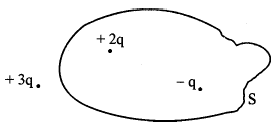
Figure shows three point charges, + 2q, – q and + 3q. Two charges + 2q and – q are enclosed within a surface ‘S’. What is the electric flux due to this configuration through the surface ‘S’?

A charged particle is projected at a very high speed perpendicular to a uniform magnetic field. The particle will:
  1. Move along a circle.
  2. Move along a curve with increasing radius of curvature.
  3. Move along a curve with decreasing radius of curvature.
  4. Move along a straight line.
An object is placed far away from all the objects that can exert force on it. A frame of reference is constructed by taking the origin and axes fixed in this object. Will the frame be necessarily inertial?
Lenz's law is based on conservation of which physical quantity?
Two alternating currents are given by, $\text{i}_\text{i}=\text{i}_0\sin\omega\text{t}$ and $\text{i}_\text{i}=\text{i}_0\sin\Big(\omega\text{t}+\frac{\pi}{3}\Big)$ Will the rms values of the currents be equal or different?
A particle executing simple harmonic motion comes to rest at the extreme positions. Is the resultant force on the particle zero at these positions according to Newton's first law?
When a straight wire of resistance R is bent into U-shape, does its resistance change?
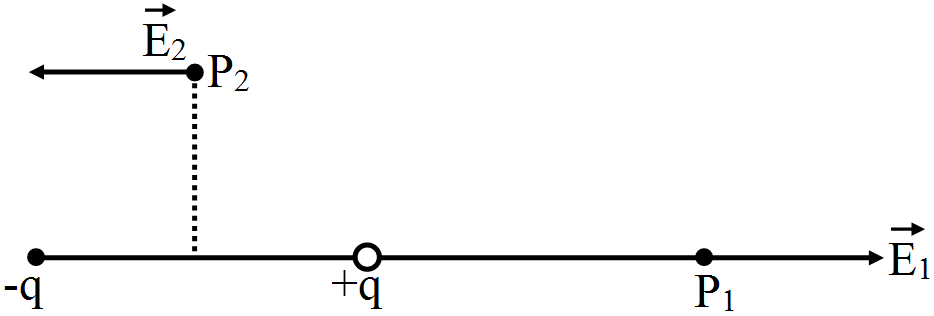
What is the angle between the directions of electric field at any (i) Axial point and (ii) Equatorial point due to an electric dipole?

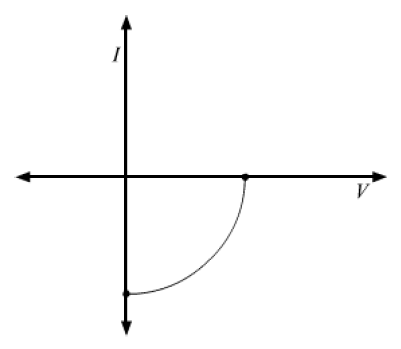
Name the junction diode whose I-V characteristics are drawn below:

How electromagnetic radio waves are produced?