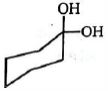
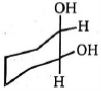
MCQ
What is the major product expected from the following reaction ?
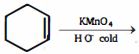
  • A


  • C

  • D

Answer

Correct option: B.

b
$(b)$ cis-diol will form (syn addition takes place)

Need a full question paper?

Generate a complete, print-ready paper with questions like this in minutes — across 16+ boards, with answer keys.

Start Generating Free

Similar questions

Electronic configuration of $S{c^{21}}$ is
For a system in equilibrium $\Delta G = 0$ under conditions of constant
Which one is oxidising agent in the reaction below

$2CrO_4^{2 - } + 2{H^ + } \to C{r_2}O_7^{2 - } + {H_2}O$

$\begin{array}{*{20}{c}}
  {C{H_3} - C{H_2} - CH - C{H_3}\xrightarrow[{KOH}]{{Alc.}}\mathop X\limits_{\left( {{\text{major}}} \right)} \,;} \\ 
  {\,\,\,\,\,\,\,\,\,\,\,\,|\,\,\,\,\,\,\,\,\,\,\,\,\,\,\,\,\,\,\,\,\,\,\,\,\,\,\,\,\,\,\,} \\ 
  {\,\,\,\,\,\,\,\,\,\,\,\,\,Br\,\,\,\,\,\,\,\,\,\,\,\,\,\,\,\,\,\,\,\,\,\,\,\,\,\,\,\,\,} 
\end{array}\,$

$\begin{array}{*{20}{c}}
  {C{H_3} - C{H_2} - CH - C{H_3}\xrightarrow[\Delta ]{{EtoNa}}\mathop {{\text{ }}Y}\limits_{\left( {{\text{major}}} \right)} } \\ 
  {{\mkern 1mu} {\mkern 1mu} {\mkern 1mu} {\mkern 1mu} {\mkern 1mu} {\mkern 1mu} {\mkern 1mu} {\mkern 1mu} {\mkern 1mu} {\mkern 1mu} {\mkern 1mu} {\mkern 1mu} |{\mkern 1mu} {\mkern 1mu} {\mkern 1mu} {\mkern 1mu} {\mkern 1mu} {\mkern 1mu} \,\,\,\,\,{\mkern 1mu} \,\,\,\,{\mkern 1mu} {\mkern 1mu} {\mkern 1mu} {\mkern 1mu} {\mkern 1mu} {\mkern 1mu} {\mkern 1mu} {\mkern 1mu} {\mkern 1mu} {\mkern 1mu} {\mkern 1mu} {\mkern 1mu} {\mkern 1mu} {\mkern 1mu} {\mkern 1mu} {\mkern 1mu} {\mkern 1mu} {\mkern 1mu} {\mkern 1mu} {\mkern 1mu} {\mkern 1mu} {\mkern 1mu} {\mkern 1mu} {\mkern 1mu} } \\ 
  {{\mkern 1mu} {\mkern 1mu} {\mkern 1mu} \mathop {{\mkern 1mu} {\mkern 1mu} {\mkern 1mu} {\mkern 1mu} \,\,\,\,\,\,\,NM{e_3}\,\,\,\,\,\,\,{\mkern 1mu} }\limits_{\,\,\,\,\,\,\,\,\,\, \oplus \,\,\,\,\,\,\,\,\,\,\,\,\,\,\,\,\,\,\,\,} {\mkern 1mu} {\mkern 1mu} {\mkern 1mu} {\mkern 1mu} {\mkern 1mu} {\mkern 1mu} {\mkern 1mu} {\mkern 1mu} {\mkern 1mu} {\mkern 1mu} {\mkern 1mu} {\mkern 1mu} {\mkern 1mu} {\mkern 1mu} } 
\end{array}{\mkern 1mu} $

Product $(X)$ and $(Y)$ respectively is

Positive ions are formed from the neutral atom by the
Consider the sulphides $\mathrm{HgS}, \mathrm{PbS}, \mathrm{CuS}, \mathrm{Sb}_{2} \mathrm{~S}_{3}$, $\mathrm{As}_{2} \mathrm{~S}_{3}$ and $\mathrm{CdS}$. Number of these sulphides soluble in $50\, \% \,\mathrm{HNO}_{3}$ is .... .
The first order rate constant for the decomposition of $\mathrm{CaCO}_{3}$ at $700\, \mathrm{~K}$ is $6.36 \times 10^{-3}\, \mathrm{~s}^{-1}$ and activation energy is $209\, \mathrm{~kJ} \,\mathrm{~mol}^{-1}$. Its rate constant (in $\mathrm{s}^{-1}$ ) at $500\, \mathrm{~K}$ is $\mathrm{x} \times 10^{-6}$. The value of $\mathrm{x}$ is ..... . Nearest integer)

Given $\mathrm{R}=8.31\, \mathrm{~J} \,\mathrm{~K}^{-1} \,\mathrm{~mol}^{-1} ; \log 6.36 \times 10^{-3}=-2.19$ $\left.10^{-4.79}=1.62 \times 10^{-5}\right]$

Which of the following series correctly represents relations between the elements from $X$ to $Y$ ? $X \to Y$
Boiling point of chloroform was raised by $ 0.323\,K$, when $0.5143\,g$ of anthracene was dissolved in $35\,g$ of chloroform. Molecular mass of anthracene is ....... $g/mol$. (${K_b}$ for $CHC{l_3}$ $= 3.9 \,\,kg\, mol^{-1}$)
Spectrum of $L{i^{2 + }}$ is similar to that of