MCQ
What is the maximum number of open chain structures possible for ${C_4}{H_8}$
- A$2$
- ✓$4$
- C$3$
- D$1$
${H_2}C = CH - C{H_2} - C{H_3}$
$C{H_3} - CH = CH - C{H_3}$ (cis-trans)
$\begin{array}{*{20}{c}}
{C{H_3} - C = C{H_2}} \\
| \\
{\,\,\,\,C{H_3}}
\end{array}$
Generate a complete, print-ready paper with questions like this in minutes — across 16+ boards, with answer keys.

Given : $K_f (H_2O)$ = $2\ K\ kg\ mole^{-1}$, $K_{sp} (PbCl_2)$ = $4 × 10^{-6}$
(Assume molarity to be equal to molality) .....$^oC$
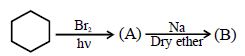
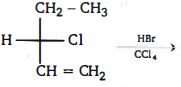
$(i)$ In pure water
$(ii)$ In presence of $0.1\ M AgNO_3$
$(iii)$ In presence of $2\ M aq.$ solution of $KCN$
$(iv)$ In presence of $ 1\ M aq$. solution of $Ca(CN)_2$
$(v)$ In presence of $2\ M aq.$ solution of $NH_3$
(Assuming $100\%$ dissociation of $AgNO_3, KCN$ and $Ca(CN)_2)$ and complex formation with $NH_3$ and $CN^-$ will take place.