MCQ
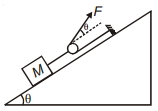
What is the minimum value of $F$ needed so that block begins to move upward on frictionless incline plane as shown
  • $M g \tan \left(\frac{\theta}{2}\right)$
  • B
    $M g \cot \left(\frac{\theta}{2}\right)$
  • C
    $\frac{M g \sin \theta}{(1+\sin \theta)}$
  • D
    $M g \sin \left(\frac{\theta}{2}\right)$
Answer

Correct option: A.
$M g \tan \left(\frac{\theta}{2}\right)$
a
(a)

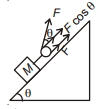
$F+F \cos \theta=m g \sin \theta$

$F=\frac{m g \sin \theta}{1+\cos \theta}$

$F=\frac{m g 2 \sin \frac{\theta}{2} \cos \frac{\theta}{2}}{2 \cos ^2 \frac{\theta}{2}}$ $\left(\because \sin \theta=2 \sin \frac{\theta}{2} \cdot \cos \frac{\theta}{2}\right.$ and $\left.1+\cos \theta=2 \cos ^2 \frac{\theta}{2}\right)$

$=m g \tan \frac{\theta}{2}$

Need a full question paper?

Generate a complete, print-ready paper with questions like this in minutes — across 16+ boards, with answer keys.

Start Generating Free

Similar questions

If the time of flight of a bullet over a horizontal range $R$ is $T\, seconds$, the inclination of the direction of projection to the horizontal is
A monoatomic idea gas expands at constant pressure, with heat $Q$ supplied. The fraction of $Q$ which goes as work done by the gas is 
A projectile thrown with velocity $v$ making angle $\theta$ with vertical gains maximum height $H$ in the time for which the projectile remains in air, the time period is
A particle moving in a circle of radius $R$ with uniform speed takes time $\mathrm{T}$ to complete one revolution. If this particle is projected with the same speed at an angle $\theta$ to the horizontal, the maximum height attained by it is equal to $4 R$. The angle of projection $\theta$ is then given by :
$Assertion :$ Solids are least compressible and gases are most compressible.
$Reason :$ solids have definite shape and volume but gases do not have either definite shape or definite volume.
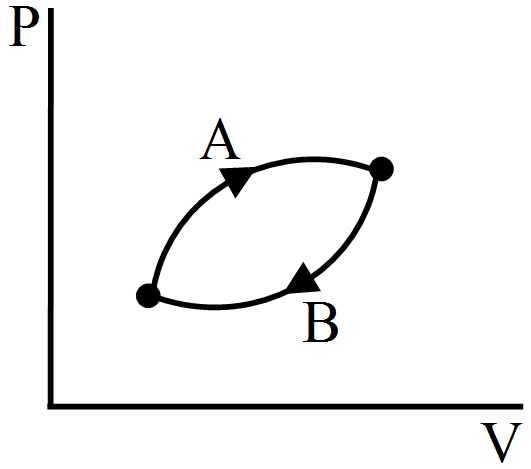
Refer to figure. Let $\Delta\text{U}_1$ and $\Delta\text{U}_2$ be the change in internal energy in processes $A$ and $B$ respectively, $\Delta\text{Q}$ be the net heat given to the system in process $A + B$ and $\Delta \text{W}$ be the net work done by the system in the process $A + B.$
  1. $\Delta\text{U}_1+\Delta\text{U}_2=0$
  2. $\Delta\text{U}_1-\Delta\text{U}_2=0$
  3. $\Delta\text{Q}-\Delta\text{W}=0$
  4. $\Delta\text{Q}+\Delta\text{W}=0$
A rocket with a lift-off mass $2 \times 10^4\,kg$ is blasted upwards with an intial acceleration of $5\,m\,s^{-2}$ . The initial thrust of the blast is (Take $g = 10\,m\,s^{-2}$ )
The temperature of a wire is doubled. The Young’s modulus of elasticity
Two point masses of $0.3\, kg$ and $0.7\, kg$ are fixed at the ends of a rod of length $1.4\, m$ and of negligible mass. The rod is set rotating about an axis perpendicular to its length with a uniform angular speed. The point on the rod through which the axis should pass in order that the work required for rotation of the rod is minimum is located at a distance of
A sphere is rolled on a rough horizontal surface. It gradually slows down and stops. The force of friction tries to:
  1. Decrease the linear velocity.
  2. Increase the angular velocity.
  3. Increase the linear momentum.
  4. Decrease the angular velocity.