MCQ
What is the monomer of polypeptide
  • Amino acid
  • B
    Glucose
  • C
    Nucleoside
  • D
    Nucleotide

Answer

Correct option: A.
Amino acid
a
Polypeptide chains are long strings of amino acids held together by peptide bonds. Amino Acids Are Linked by Peptide Bonds to Form Polypeptide Chains. Proteins are linear polymers formed by linking the $\alpha$-carboxyl group of one amino acid to the $\alpha$-amino group of another amino acid with a peptide bond (also called an amide bond).

Need a full question paper?

Generate a complete, print-ready paper with questions like this in minutes — across 16+ boards, with answer keys.
Start Generating Free

Similar questions

$\,$
Which concentrations can be calculated if the mole fraction and density of an aqueous solution of $HCl$ are known? $1.$ Molality $2.$ Molarity $3.$ Percentage by mass
${K_4}[Fe{(CN)_6}] + \,{M^{x + }}(aq.) \to \mathop {{M_4}{{[Fe{{(CN)}_6}]}_x}}\limits_{Coloured\,\,precipirate} \, \downarrow $

Which of the following cation does not respond to the above reaction ?

Which of following do not gives alcohol with $NaBH_4$
A mixture of $H_2$ and sufficient quantity of air at $25\,^oC$ aild $1\ atm$ pressure undergoes complete combustion in a closed rigid adiabatic container leaving behind $H_2O(g)$ and $N_2(g)$. If air is a mixture of $80\% N_2$ and $20\%O_2$ by volume and $C_{P(N_2 )}$ and $C_{P(H_2O)g}$ are $7.0$ and $8.0\  cal-deg^{- 1}\  mol^{-1}$ respectively. What will be max imum temperature attained ?

( Given that : ${\left( {\Delta {H^o}_f} \right)_{{H_2}O(g)}} =  - 56.0\,\,kcal/mol$ and it is independnet of temperature).......$ K$ 

$3\, mole\, N_2H_4$ will lose $30 \,mole$ electrons to give new compound. Calculate  oxidation state of $N$ in new compound? (Oxidation state of $H$ remains unchanged)
In the given reaction, the oxide of sodium is ….$\left[ {\begin{array}{*{20}{c}}{4Na + {O_2} \to 2N{a_2}O}\\{N{a_2}O + {H_2}O \to 2NaOH}\end{array}} \right]$
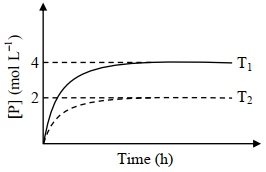
In a one-litre flask, 6 moles of $A$ undergoes the reaction $A(\mathrm{~g}) \rightleftharpoons \mathrm{P}(\mathrm{g})$. The progress of product formation at two temperatures (in Kelvin), $\mathrm{T}_1$ and $\mathrm{T}_2$, is shown in the figure:

If $T_1=2 T_2$ and $\left(\Delta G_2^{\Theta}-\Delta G_1^{\varphi}\right)=R T_2 \ln x$, then the value of $x$ is. . . . .

$\left[\Delta G_1^\theta\right.$ and $\Delta G_2^\theta$ are standard Gibb's free energy change for the reaction at temperatures $T_1$ and $T_2$, respectively.]
Complexes formed in the following methods are :

$(I)$ Mond's process for purification of nickel
$(II)$ Removal of unreacted $AgBr$ from photographic plate
$(III)$ Removal of lead poisoning from the body

$I$ $-$ $II$  $-$ $III$

In reaction ${N_{2(g)}} + 3{H_{2(g)}}$ $\rightleftharpoons$ $2N{H_{3(g)}};\,\Delta H = - 93.6\,kJ$, the yield of ammonia does not increase when