MCQ
What is the order of potential difference built up by the Van de Graff generator?
  • A
    Potential difference of the order of hundreds.
  • Potential difference of the order of several million volts.
  • C
    Potential difference of the order of thousands.
  • D
    Potential difference of the order of tens.
Answer

Correct option: B.
Potential difference of the order of several million volts.
A Van de Graff generator, by means of a moving belt and suitable brushes, transfers charge continuously to a large spherical conducting shell. As a result, a potential difference of the order of several million volts is built up and this can be used for accelerating charged particles.

Need a full question paper?

Generate a complete, print-ready paper with questions like this in minutes — across 16+ boards, with answer keys.

Start Generating Free

Similar questions

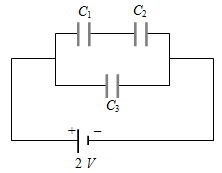
Two capacitors ${C}_1=2 \mu{F}$ and ${C}_6=2 \mu{F}$ in series, are connected in parallel to a third capacitor${C}_3=4 \mu{F}$. This arrangement is then connected to a battery of e.m.f. = 2V, as shown in the figure. How much energy is lost by the battery in charging the capacitors
For a photoelectric cell the graph showing the variation of cut of voltage ($V_o$) with frequency $(v)$ of incident light is best represented by
If the charge on a capacitor is increased by $2C$, the energy stored in it increases by $44 \%$. The original charge on the capacitor is (in $C$ )
Two similar spheres having $ + \,q$ and $ - \,q$ charge are kept at a certain distance. $F$ force acts between the two. If in the middle of two spheres, another similar sphere having $ + \,q$ charge is kept, then it experience a force in magnitude and direction as
The activity of a freshly prepared radioactive sample is $10^{10}$ disintegrations per second, whose mean life is $10^9 s$. The mass of an atom of this radioisotope is $10^{-25} kg$. The mass (in $mg$ ) of the radioactive sample is
There is a uniformly charged non conducting solid sphere made of material of dielectric constant one. If electric potential at infinity be zero, then the potential at its surface is $V$. If we take electric potential at its surface to be zero, then the potential at the centre will be
A car of mass $1000\,kg$ negotiates a banked curve of radius $90\,m$ on a fictionless road. If the banking angle is $45^o$, the speed of the car is ......... $ms^{-1}$
Which of the following is not an application of eddy currents
The net resistance of an ammeter should be small to ensure that:
The approximate ratio of resistances in the forward and reverse bias of the PN-junction diode is