What is the period of small oscillations of the block of mass $m$ if the springs are ideal and pulleys are massless ?
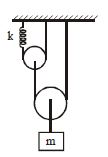
Advanced
Download our app for free and get started
$2 T=m g$
$m g=4 k x_{0}$
$\frac{T}{2}=k x_{0}$
$T=2 k x_{0}$
if displaced
$m g-2 T=m a$
$m g-4 k\left(x_{0}+x\right)=m a$
$\frac{T}{2}=k\left(x_{0}+x\right)$
$T=2 k\left(x_{0}+x\right)$
$T=2 \pi \sqrt{\frac{m}{4 k}}=\pi \sqrt{\frac{m}{k}}$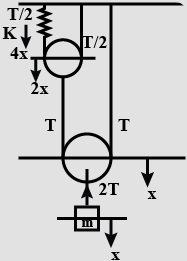

Download our appand get started for free
Experience the future of education. Simply download our apps or reach out to us for more information. Let's shape the future of learning together!No signup needed.*
Similar Questions
- 1The amplitude of a particle executing $SHM$ is $3\,cm$. The displacement at which its kinetic energy will be $25 \%$ more than the potential energy is: $.............cm$.View Solution
- 2A body executes $SHM$ under the influence of one force and has a period $T_1\, second$ and the same body executes $SHM$ with period $T_2\, second$ when under the influence of another force. When bothforces act simultaneously and in the same direction, then the time period of the same body isView Solution
- 3The potential energy of a simple harmonic oscillator of mass $2\, kg$ in its mean position is $5\, J.$ If its total energy is $9\,J$ and its amplitude is $0.01\, m,$ its time period would beView Solution
- 4To find the spring constant $(k)$ of a spring experimentally, a student commits $2 \%$ positive error in the measurement of time and $1 \%$ negative error in measurement of mass. The percentage error in determining value of $\mathrm{k}$ is :View Solution
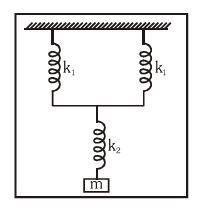
- 5View SolutionThe total spring constant of the system as shown in the figure will be
- 6View SolutionA simple pendulum is vibrating in an evacuated chamber, it will oscillate with
- 7View SolutionThe total energy of a particle, executing simple harmonic motion is
- 8A spring has a certain mass suspended from it and its period for vertical oscillation is $T$. The spring is now cut into two equal halves and the same mass is suspended from one of the halves. The period of vertical oscillation is nowView Solution
- 9A particle doing simple harmonic motion, amplitude $= 4\, cm$, time period $= 12\, sec$. The ratio between time taken by it in going from its mean position to $2 \,cm$ and from $2\, cm$ to extreme position isView Solution
- 10A particle performs $SHM$ on $x-$ axis with time period of $0.5\,sec,$ such that it's velocity is zero at $x = -3\,cm$ and at $x = 9\,cm$. It was located at $x = 0$ and moving in negative $'x'$ at $t = 0$. The equation of $SHM$ of the particle isView Solution