MCQ
What is the phase difference between two successive crests in the wave
  • A
    $\pi$
  • B
    $\pi /2$
  • $2 \pi$
  • D
    $4 \pi$

Answer

Correct option: C.
$2 \pi$
c
(c) Since distance between two consecutive crests is $\lambda$, so

$\phi = \frac{{2\pi }}{\lambda } \times \lambda = 2\pi .$

Need a full question paper?

Generate a complete, print-ready paper with questions like this in minutes — across 16+ boards, with answer keys.
Start Generating Free

Similar questions

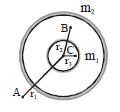
Two concentric shells of different masses $m_1$ and $m_2$ are having a sliding particle of mass $m$. The forces on the particle at position $A, B$ and $C$ are
The coefficient of restitution $e$ for a perfectly elastic collision is
Equation of motion in the same direction is given by ${y_1} = A\sin (\omega t - kx)$, ${y_2} = A\sin (\omega t - kx - \theta )$. The amplitude of the medium particle will be
The diagonals of a parallelogram are $2\,\hat i$ and $2\hat j.$What is the area of the parallelogram.........$units$
A cricket ball is thrown up with a speed of $ 19.6\, ms^{-1}$. The maximum height it can reach is.........$m$
The engine of a motorcycle can produce a maximum acceleration $5 \,ms^{-2}$. Its brakes can produce a maximum retardation $10\, ms^{-2}$. What is the minimum time in which it can cover a distance of $1.5\, km$.........$sec$
It is easier to draw up a wooden block along an inclined plane than to haul it vertically, principally because
The speed of a transverse wave passing through a string of length $50 \;cm$ and mass $10\,g$ is $60\,ms ^{-1}$. The area of cross-section of the wire is $2.0\,mm ^{2}$ and its Young's modulus is $1.2 \times 10^{11}\,Nm ^{-2}$. The extension of the wire over its natural length due to its tension will be $x \times 10^{-5}\; m$. The value of $x$ is $...$
An electric motor creates a tension of  $4500$  newton in a hoisting cable and reels it in at the rate of $2 m/sec. $ What is the power of electric motor
A piece of wood is taken deep inside a long column of water and released. It will move up:
  1. With a constant upward acceleration.
  2. With a decreasing upward acceleration.
  3. With a deceleration.
  4. With a uniform velocity.