Question
What is the probability that an ordinary year has 53 Mondays?

Answer

There are 365 days in an ordinary year,
Total number of outcomes = 365
Since in an ordinary year there are 52 weeks,
There will surely be 52 Mondays.
Now, 52 × 7 = 364 days
So, the last day could be any of the 7 days of the week.
Thus, P(the last day is a Monday)
$=\frac{1}{7}$

Need a full question paper?

Generate a complete, print-ready paper with questions like this in minutes — across 16+ boards, with answer keys.
Start Generating Free

Similar questions

Evaluate:
$\text{cosec }(65^\circ+\theta)-\sec(25^\circ-\theta)-\tan(55^\circ-\theta)+\cot(35^\circ+\theta)$
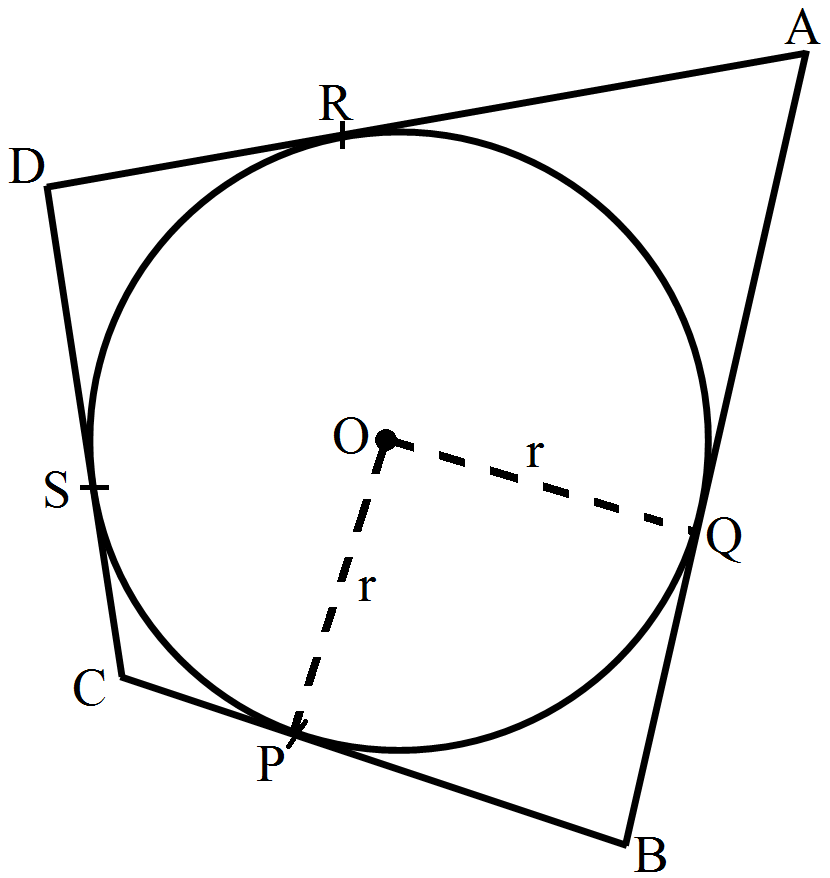
In the given figure, a circle with centre O, is inscribed in a quadrilateral ABCD such that it touches the side BC, AB, AD and CD at points P, Q, R and S respectively. If AB = 29cm, AD = 23cm, $\angle\text{B} = 90^\circ$and DS = 5cm then find the radius of the circle.
In the following, one of the six trigonometric ratios is given. Find the values of the other trigonometric ratios.
$\cos\theta=\frac{12}{15}$
Write the lower limit of the modal class of the following frequency distribution?
Age (in years)
0-10
10-20
20-30
30-40
40-50
50-60
Number of patients
16
13
6
11
27
18
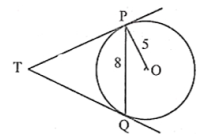
In Fig., PQ is a chord of length 8 cm of a circle of radius 5 cm and centre $O$. The tangents at $P$ and $Q$ intersect at point T. Find the length of TP.
Image
Very-short and Short-Answer Questions.
Write the value of $\text{cosec}^2\theta(1+\cos\theta)(1-\sin\theta).$
The point $R$ divides the line segment $A B$, where $A(-4,0)$ and $B(0,6)$ such that $A R=\frac{3}{4} A B$. Find the coordinates of $R$.
Solve the pair of linear equations by substitution method:
$\sqrt { 2 } x - \sqrt { 3 } y = 0$
$\sqrt { 3 } x - \sqrt { 8 } y = 0$
On comparing the ratios $ \frac { a _ { 1 } } { a _ { 2 } } , \frac { b _ { 1 } } { b _ { 2 } } $ and $\frac {c_1}{c_2}$, find out whether the pair of linear equations are consistent, or inconsistent: $ \frac { 3 } { 2 } x + \frac { 5 } { 3 } y = 7,$ 9x − 10y = 14
Are the given numbers form an AP? If they form an AP, write the next two terms: $1, -1, -3, -5, ...$