Question
What is the projection of $\hat{\text{i}}+\hat{\text{j}}$ on $(\hat{\text{i}}-\hat{\text{j}})?$

Answer

Let $\vec{\text{A}}=\hat{\text{i}}+\hat{\text{j}}$ and $\vec{\text{B}}=\hat{\text{i}}-\hat{\text{j}}$ Projection of $\vec{\text{A}}$ on $\vec{\text{B}}=|\vec{\text{A}}||\vec{\text{B}}|\cos\theta$ $\cos\theta=\frac{\vec{\text{A}}.\vec{\text{B}}}{|\vec{\text{A}}||\vec{\text{B}}|}=0$ $(\theta=90^\circ)$ $\theta=90^\circ,$ $\therefore$ Projection = 0.

Need a full question paper?

Generate a complete, print-ready paper with questions like this in minutes — across 16+ boards, with answer keys.
Start Generating Free

Similar questions

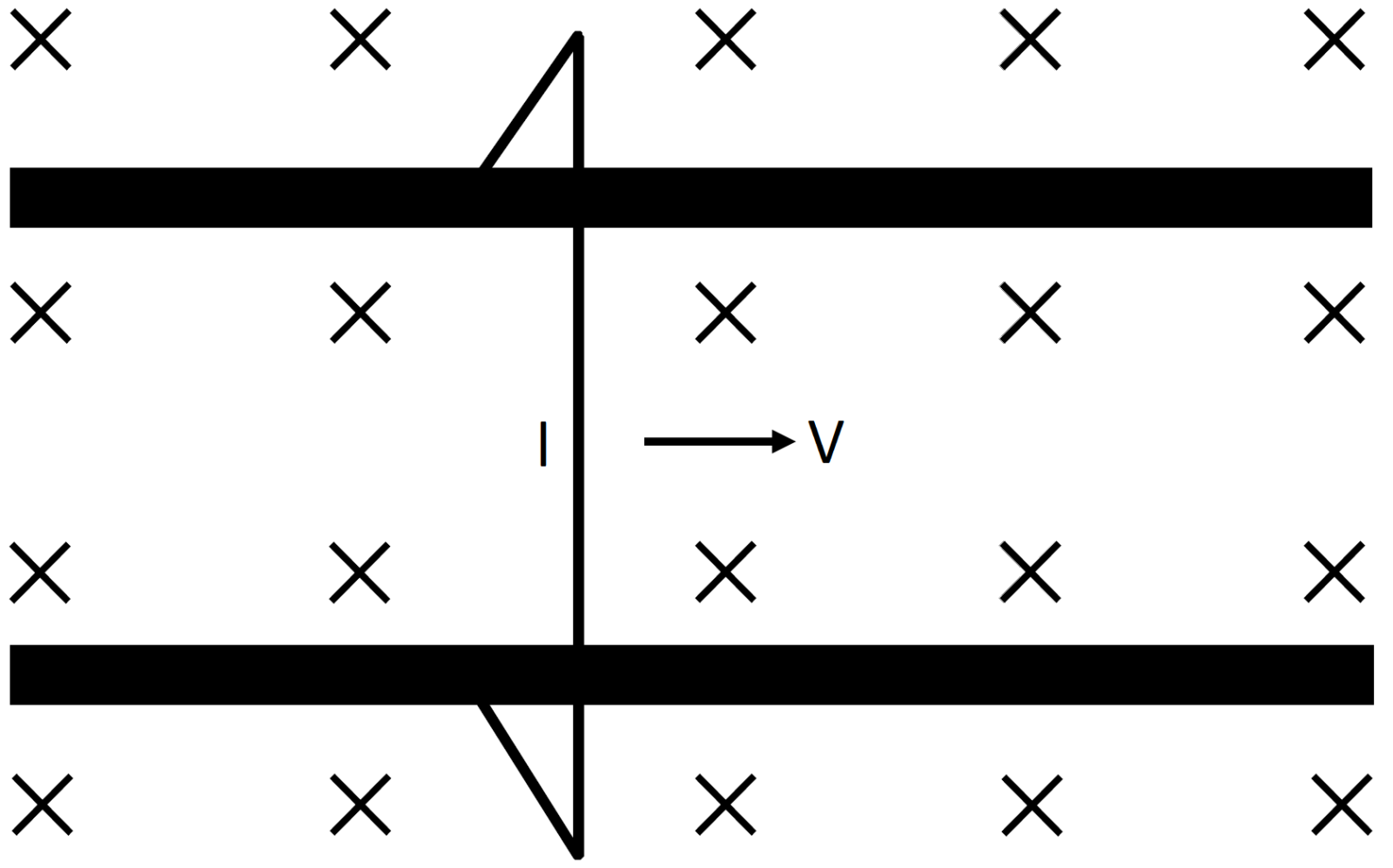
Figure shows a wire sliding on two parallel, conducting rails placed at a separation l. A magnetic field B exists in a direction perpendicular to the plane of the rails. What force is necessary to keep the wire moving at a constant velocity v?
Why can't we use a pendulum to work as a clock in a satellite?
A sphere starts rolling down an incline of inclination $\theta.$ Find the speed of its centre when it has covered a distance l.
An object moving on a straight line covers first half of the distance at speed $v$ and second half of the distance at speed $2v.$ Find:
  1. Aaverage speed.
  2. Mean speed.
When a labourer cuts down a tree, he makes a cut on the side facing the direction in which he wants it to fall.Why?
Example 5.4 In a ballistics demonstration a police officer fires a bullet of mass $50.0 g$ with speed $200 m s ^{-1}$ (see Table 5.2) on soft plywood of thickness $2.00 cm$. The bullet emerges with only $10 \%$ of its initial kinetic energy. What is the emergent speed of the bullet?
Two soap bubbles in vacuum having radii 3cm and 4cm respectively coalesce under isothermal conditions to form a single bubble. What is the radius of the new bubble?
The gravitational field in a region is given by $\text{E}=(2\hat{\text{i}}+3\hat{\text{i}})\text{N/kg}.$ Show that no work is done by the gravitational field when a particle is moved on the line 3y + 2x = 5.
Hint: If a line y = mx + c makes angle $\theta$ with the X-axis, m $=\tan\theta$
Calculate the solid angle subtended by the periphery of an area of $1\text{cm}^2$ at a point situated symmetrically at a distance of 5cm from the area.
Give two properties of Carnot's engine as compared to other engines. $($Carnot's theorem$).$