MCQ
What is the relation between displacement, time and acceleration in case of a body having uniform acceleration
  • $S = ut + \frac{1}{2}f{t^2}$
  • B
    $S = (u + f)\;t$
  • C
    $S = {v^2} - 2fs$
  • D
    None of these

Answer

Correct option: A.
$S = ut + \frac{1}{2}f{t^2}$
a
(a)

Need a full question paper?

Generate a complete, print-ready paper with questions like this in minutes — across 16+ boards, with answer keys.

Start Generating Free

Similar questions

A particle of mass $m$ slides from rest down a plane inclined at $30^o$ to the horizontal. The force of resistance acting on the particle during motion is $ms^2$ where $s$ is the displacement of the particle from its initial position. The velocity (in $m/s$) of the particle when $s = 1\,m$ is $v$. The value of $\frac{3v^2}{14}$ is :-
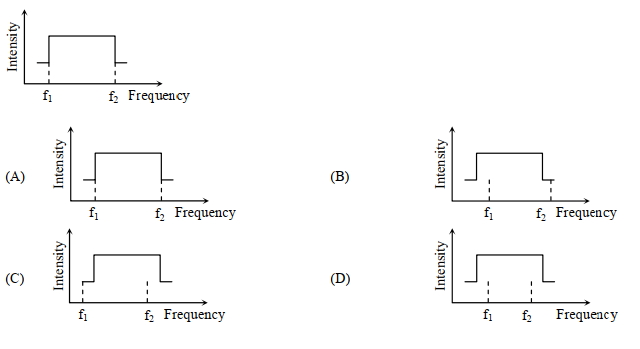
Two trains $A$ and $B$ are moving with speeds $20 \mathrm{~m} / \mathrm{s}$ and $30 \mathrm{~m} / \mathrm{s}$ respectively in the same direction on the same straight track, with $B$ ahead of $A$. The engines are at the front ends. The engine of train  $A$ blows a long whistle.

Assume that the sound of the whistle is composed of components varying in frequency from $f_1=800 \mathrm{~Hz}$ to $f_2=1120 \mathrm{~Hz}$, as shown in the figure. The spread in the frequency (highest frequency - lowest frequency) is thus $320 \mathrm{~Hz}$. The speed of sound in still air is $340 \mathrm{~m} / \mathrm{s}$.

$1.$  The speed of sound of the whistle is

$(A)$ $340 \mathrm{~m} / \mathrm{s}$ for passengers in $A$ and $310 \mathrm{~m} / \mathrm{s}$ for passengers in $B$

$(B)$ $360 \mathrm{~m} / \mathrm{s}$ for passengers in $A$ and $310 \mathrm{~m} / \mathrm{s}$ for passengers in $B$

$(C)$ $310 \mathrm{~m} / \mathrm{s}$ for passengers in $A$ and $360 \mathrm{~m} / \mathrm{s}$ for passengers in $B$

$(D)$ $340 \mathrm{~m} / \mathrm{s}$ for passengers in both the trains

$2.$  The distribution of the sound intensity of the whistle as observed by the passengers in train $\mathrm{A}$ is best represented by

$Image$

$3.$  The spread of frequency as observed by the passengers in train $B$ is

$(A)$ $310 \mathrm{~Hz}$ $(B)$ $330 \mathrm{~Hz}$ $(C)$ $350 \mathrm{~Hz}$ $(D)$ $290 \mathrm{~Hz}$

Give the answer question $1,2$ and $3.$
If there is an error of $1\%$ in calculation of mass of disc and $1.5\%$ error in radius, then $\%$ error in moment of inertia about an axis tangent to disc is  .......... $\%$
If the surface tension of water is $0.06\, Nm^{-1}$, then the capillary rise in a tube of diameter $1 \,mm $ is ....... $cm$ ($\theta =0^°$ )
$Erg - {m^{ - 1}}$ can be the unit of measure for
The mean radius of the earth is $R,$ its angular speed about its own axis is $o$ and the acceleration due to gravity at earth surface is $g.$ The cube of radius of orbit of 'geostationary satellite' will be:
A body is moving unidirectionally under the influence of a source of constant power supplying energy. Which of the diagrams shown in correctly shows the displacement-time curve for its motion?
Two simple pendulums of length $0.5\, m$ and $2.0\, m$ respectively are given small linear displacement in one direction at the same time. They will again be in the phase when the pendulum of shorter length has completed .... oscillations.
A point object is placed at a distance of 30cm from a convex mirror of focal length 30cm. The image will form at:
How many wavelength of $Kr^{86}$ are there in $1m?$