Question
What is the relationship between the total energy and oscillation frequency of a simple pendulum?

Answer

$\begin{aligned} \text { Total energy } & =\frac{1}{2} m \omega^2 A^2 \\ \text { But } \omega & =2 \pi n \\ \text { Total energy } & =\frac{1}{2} m(2 \pi n)^2 A^2=2 \pi^2 m n^2 A^2\end{aligned}$

Need a full question paper?

Generate a complete, print-ready paper with questions like this in minutes — across 16+ boards, with answer keys.

Start Generating Free

Similar questions

Would you prefer a voltmeter or a potentiometer to measure the emf of a battery?
A simple pendulum is a point mass suspended by a light thread from a fixed point. The particle is displaced towards one side and then released. It makes small oscillations. Is the motion of such a simple pendulum a pure rotation? If yes, where is the axis of rotation?
Why does mercury drop its level in a capillary tube?
It is easier to maintain the motion of a body than to start it. Why?
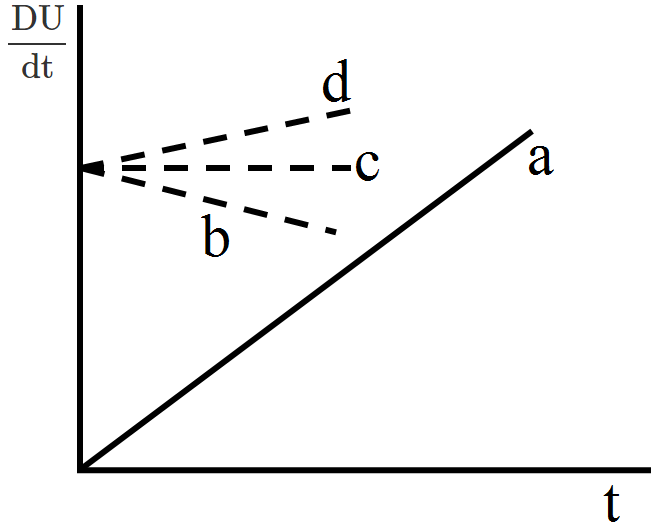
A constant current i is passed through a resistor. Taking the temperature coefficient of resistance into account, indicate which of the plots shown in figure best represents the rate of production of thermal energy in the resistor.
Textbooks on science may give you a wrong impression that studying science is dry and all too serious and that scientists are absent-minded introverts who never laugh or grin. This image of science and scientists is patently false. Scientists, like any other group of humans, have their share of humorists, and many have led their lives with a great sense of fun and adventure, even as they seriously pursued their scientific work. Two great physicists of this genre are Gamow and Feynman. You will enjoy reading their books listed in the Bibliography.
What are the two conditions when a real gas follow the ideal gas equation PV = nRT?
A 50kg man is running at a speed of $18kmh^{-1}$. If all the kinetic energy of the man can be used to increase the temperature of water from 20°C to 30°C, how much water can be heated with this energy?
A thermos flask containing tea is shaken vigorously considering tea as a system.
  1. Has heat been added to tea?
  2. Has work been done on it?
  3. Has its internal energy changed?
  4. Does its temperature rise?
When a particle moves with constant velocity, its average velocity, its instantaneous velocity and its speed are all equal. Comment on this statement.