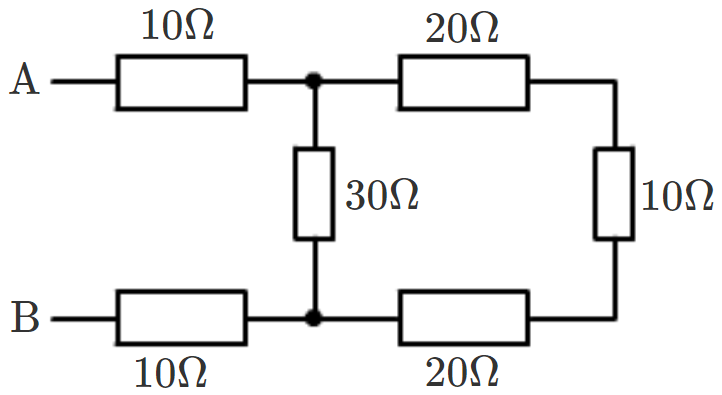
What is the resistance between A and B in the figure given below?
Download our app for free and get started
The three resistance of 20 ohm, 10 ohm and 20 ohm on the extreme right side are in series.
So, the resultant of these three resistance = 20 + 20 + 10 = 50 ohms.
This 50 ohms is in parallel with 30 ohms. so resultant of these two will be
$\frac{1}{\text{R}}=\frac{1}{30}+\frac{1}{50}$
$\frac{1}{\text{R}}=\frac{80}{1500}$
R = 18.75 ohms
Now, the resistance 10 ohms, 18.75 ohms and 10 ohms are in series.
Therefore, resultant resistance = 18.75 + 10 + 10 = 38.75 ohms.
Download our app
and get started for free
Experience the future of education. Simply download our apps or reach out to us for more information. Let's shape the future of learning together!No signup needed.*
The resistors $R_1 , R_2 , R_3$ and $R_4$ in the figure given below are all equal in value.
What would you expect the voltmeters $A, B$ and $C$ to read assuming that the connecting wires in the circuit have negligible resistance?
What is a circuit diagram? Draw the labelled diagram of an electric circuit comprising of a cell, a resistor, an ammeter, a voltmeter and a closed switch (or closed plug key). Which of the two has a large resistance: an ammeter or a voltmeter?
A resistor has a resistance of 176 ohms. How many of these resistors should be connected in parallel so that their combination draws a current of 5 amperes from a 220 volt supply line?
A resistance of $40$ ohms and one of $60$ ohms are arranged in series across $220$ volt supply. Find the heat in joules produced by this combination of resistances in half a minute.