MCQ
What is the S.I. unit of electric potential?
- AAmpere
- BVolt
- CVolt.m
- DCoulomb
Explanation:
An electric potential (also called the electric field potential or the electrostatic potential) is the amount of electric potential energy that a unitary point electric charge would have if located at any point of space, and is equal to the work done by an electric field in carrying a unit positive charge from infinity to that point.
This value can be calculated in either a static (time-invariant) or a dynamic (varying with time) electric field at a specific time in units of joules per coulomb, or volts (V). The electric potential at infinity is assumed to be zero.
Generate a complete, print-ready paper with questions like this in minutes — across 16+ boards, with answer keys.
Sodium and copper have work functions 2.3eV and 4.5eV respectively. Then the ratio of their threshold wavelengths is nearest to
|
(a) 1: 2 |
(b) 4 : 1 |
(c) 2 : 1 |
(d) 1 : 4 |
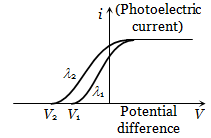
In the following diagram if V2 > V1 then
|
(a) |
(b) |
(c) |
(d) |
A convex lens of power + 6D is placed in contact with a concave lens of power – 4D. What is the nature and focal length of the combination
|
(a) Concave, 25 cm |
(b) Convex, 50 cm |
(c) Concave, 20 cm |
(d) Convex, 100 cm |


