Question
What is the smallest positive phase constant which is equivalent to $7.5\pi?$

Answer

Equation of the wave:

$\text{y}=\text{A}\sin (\text{kx}-\omega\text{t}+\phi)$

Here, A is the amplitude, k is the wave nunumber, $\omega$ is the angular frequency and $\phi$ is the initial phase.

The argument of the sine is a phase, so the smallest positive phase constant should be.

$\sin(7.5\pi)=\sin (3\times2\pi+1.5\pi)$

$=\sin (1.5\pi)$

Therefore, the smallest positive phase constant is $1.5 \pi.$

Need a full question paper?

Generate a complete, print-ready paper with questions like this in minutes — across 16+ boards, with answer keys.
Start Generating Free

Similar questions

Answer the following:
What are the forms of energy into which the electrical energy of the atmosphere is dissipated during a lightning? (Hint: The earth has an electric field of about 100Vm–1 at its surface in the downward direction, corresponding to a surface charge density = –10–9 Cm–2. Due to the slight conductivity of the atmosphere up to about 50km (beyond which it is good conductor), about + 1800C is pumped every second into the earth as a whole. The earth, however, does not get discharged since thunderstorms and lightning occurring continually all over the globe pump an equal amount of negative charge on the earth.)
Is the force acting between two point charges q1 and q2 kept at some distance apart in air attractive or repulsive when,
  1. q1q2 > 0?
  2. q1q2 < 0?
Can mirrors give rise to chromatic aberration?
The emission of photoelectrons will occur from the surface of a metal, only when the frequency of the incident light is greater than which frequency?
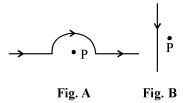
Write the direction $\otimes$ and $\odot$ of magnetic field produced at point $P$ in the given figureImage
Is magnitude of induced electromotive force in any coil depends on resistance of the circuit?
Can a hot-wire ammeter be used to measure a direct current having a constant value? Do we have to change the graduations?
Write the relation between threshold frequency and work function.
A brick weighing 4.0kg is dropped into a 1.0m deep river from a height of 2.0m. Assuming that 80% of the gravitational potential energy is finally converted into thermal energy, find this thermal energy is calorie.
Tell the value and nature of charge on the hole.