MCQ
What is the standard reduction potential $(E^o)$ for $Fe^{3+} \to Fe$ ?  ............... $\mathrm{V}$

Given that :

$F{e^{2 + }} + 2{e^ - } \to Fe;$      ${E^o}_{F{e^{2 + }}/Fe} =  - 0.47\,V$

$F{e^{3 + }} + {e^ - } \to F{e^{2 + }};$   ${E^o}_{F{e^{3 + }}/F{e^{2 + }}} =  + 0.77\,V$

  • $-0.057$
  • B
    $+0.057$
  • C
    $+0.30$
  • D
    $-0.30$

Answer

Correct option: A.
$-0.057$
a
$\Delta {G^o}\, = \, - nF{E^o}$

$(i)\,F{e^{2 + }}\, + \,2{e^ - }\, \to \,Fe;$                    ${E^o}\, = \, - 0.47\,\,V;$

$(ii)\,F{e^{3 + }}\, + \,{e^ - }\, \to \,F{e^{2 + }};$          ${E^o}\, = \, + 0.77\,\,V;$

$(iii)\,F{e^{3 + }}\, + \,3{e^ - }\, \to Fe$

$(i)\,\Delta {G^o}\, = \, - nF{E^o}\, = \, - \,2\,( - 0.47)F\, = \,0.94\,F$

$(ii)\,\Delta {G^o}\, = \, - nF{E^o}\, = \, - \,1\,( + 0.77)F\, = \, - 0.77\,F$

$(iii)$ on adding $:\,\Delta {G^o}\, = \, + \,0.17\,F$

$\Delta {G^o}\, = \, - nF{E^o}\,{E^o}$ for

$(F{e^{3 + }} \to Fe)\, = \,\frac{{\Delta {G^o}}}{{ - nF}}\,$ $ = \,\frac{{0.17F}}{{ - 3F}}\, = \, - \,0.057\,V$

Need a full question paper?

Generate a complete, print-ready paper with questions like this in minutes — across 16+ boards, with answer keys.

Start Generating Free

Similar questions

At $25\,^oC$, the values of rate constant, activation energy and Arrhenius constant of a reaction are $3 \times 10^{-4}\, sec^{-1}, 129\, kJ/mol$ and $2 \times 10^{15}\, sec^{-1}$ respectively. The value of rate constant as $T \to \infty $ is
$\begin{matrix}
   Ph-C{{H}_{2}}-CH-C{{H}_{3}}\xrightarrow{K}\xrightarrow{{{C}_{2}}{{H}_{5}}Br}(A)  \\
   |\,\,\,\,\,\,\,\,\,\,\,\,\,\,\,\,\,\,\,\,\,\,\,\,\,\,\,\, \\
   OH\,\,\,\,\,\,\,\,\,\,\,\,\,\,\,\,\,\,\,\,\,\,\,\,\,\,  \\
\end{matrix}$

Product $(A)$ in above reaction is

The conversion of acetophenone to acetanilide is best accomplished by using :
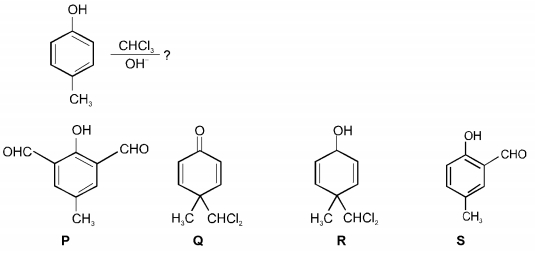
In the following reaction, the product$(s)$ formed is(are)

$(A)$ $P$ (major) $(B)$ $Q$ (minor) $(C)$ $R$ (minor) $(D)$ $S$ (major)

An aqueous solution contains $6\%$ and $4 \%$ by weight weak acid $(HA)$ and urea respectively. If depression in freezing point $ \frac{{13.6}}{3}\,^oC$. $K_a$ of $CH_3COOH$ will be [$K_f = 1.8 \,\,K-Kg/mole$]

(Molecular wight of $HA= 60, \,d_{solution} = 1\,gm/ml$)

Which of the following compounds will behave as a reducing sugar in an aqueous $KOH$ solution ?
In hydrogenation reaction at ${27\,^o}C$, it is observed that hydrogen gas pressure falls from $2\,atm$ to $1.2\,atm$ in $50\,\min$. Calculate the rate of disappearance of hydrogen
Nitrogen forms how many oxides
$\begin{array}{*{20}{c}}
  R \\ 
  H 
\end{array} > C = O\,\xrightarrow{{HS\,{{\rlap{-} (C{H_2}\rlap{-} )}_3}\,SH}}\,\xrightarrow[{n\, - \,BuLi}]{}$ $\xrightarrow{{{D_2}O}}\,\xrightarrow[{{H_2}O}]{{HgC{l_2}\,/\,CdC{O_3}}}$
Calculate the order of the reaction in $A$ and $B$

       $A$

       $(mol/l)$

      $B$

     $(mol/l)$

   Rate
       $0.05$       $0.05$  $1.2\times 10^{-3}$
       $0.10$       $0.05$  $2.4\times 10^{-3}$
       $0.05$       $0.10$  $1.2\times 10^{-3}$