MCQ
What is the stopping potential when the metal with work function $0.6 eV$ is illuminated with the light of $2 eV$ ............ $V$
  • A
    $2.6 $
  • B
    $3.6 $
  • C
    $0.8 $
  • $1.4 $

Answer

Correct option: D.
$1.4 $
d
(d) ${V_0} = \frac{{(E - {W_0})}}{e} = \frac{{(2eV - 0.6\,eV)}}{e} = 1.4V$

Need a full question paper?

Generate a complete, print-ready paper with questions like this in minutes — across 16+ boards, with answer keys.
Start Generating Free

Similar questions

A glass concave lens is placed in a liquid in which it behaves like a convergent lens. If the refractive indices of glass and liquid with respect to air are $^a{\mu _g}$ and $^a{\mu _l}$ respectively, then
A copper disc of radius 0.1 m is rotated about its centre with 10 revolutions per second in a uniform magnetic field of 0.1 Tesla with its plane perpendicular to the field. The e.m.f. induced across the radius of disc is 
In Young's double slit experiment the $ y-$ coordinates of central maxima and $10$$ ^{th}$ maxima are $2\, cm$ and $5 \,cm$ respectively. When the YDSE apparatus is immersed in a liquid of refractive index $1.5$ the corresponding $y-$ coordinates will be
The meniscus of a liquid contained in one of the limbs of a $U-$ tube is placed between the poles of an electromagnet with the meniscus in line with the field. The liquid is seen to rise in the limb by small amount. This indicates that the liquid is 
The main cause of Zener breakdown is:
A homogeneous electric field $E$ and a uniform magnetic field $\mathop B\limits^ \to $ are pointing in the same direction. A proton is projected with its velocity parallel to $\mathop E\limits^ \to $. It will
If we observe the single slit Fraunhofer diffraction with wavelength $\lambda$ and slit width $e$, the width of the central maxima is $2$$\theta$. On decreasing the slit width for the same $\lambda$
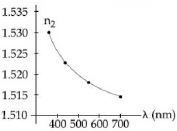
The variation of refractive index of a crown glass thin prism with wavelength of the incident light is shown. Which of the following, graph is the correct one, if $D_m$ is the angle of minimum deviation?
Two coils have a mutual inductance $0.005 \,H$. The current changes in the first coil according to equation $I = {I_0}\sin \omega \,t$, where ${I_0} = 10\,A$ and $\omega =100\pi\; radian/sec$. The maximum value of $e.m.f$. in the second coil is
Two spheres $A$ and $B$ of radius $a$ and $b$ respectively are at same electric potential. The ratio of the surface charge densities of $A$ and $B$ is