Question
What is the tertiary structure of protein?

Answer

Tertiary structure of protein: The overall shape of a single protein molecule; the spatial relationship of the secondary structures to one another. Tertiary structure is generally stabilized by non-local interactions, most commonly the formation of a hydrophobic core, but also through salt bridges, hydrogen bonds, disulfide bonds, and even post-translational modifications. The term “tertiary structure” is often used as synonymous with the term fold. The tertiary structure is what controls the basic function of the protein.
Need a full question paper?

Generate a complete, print-ready paper with questions like this in minutes — across 16+ boards, with answer keys.

Start Generating Free

Similar questions

In which fields taxonomical aids are helpful? Why taxonomic aids are used in these studies? Which different taxonomical aids are used by the biologists?
Class XI biology students attended a seminar where the speaker explained the students about the basic macromolecule found in the body, i.e., protein. He started with the monomer unit of protein and explained about different amino acids found. As amino acids are organic compounds containing an amino group and an acidic group as substituents on the same carbon; they are also considered as substituted methane. Suddenly, Ajay stood up and asked about his queries based on the topic. The guest of seminar patiently explained him all the things. Ajay became satisfied and returned home happily from the seminar.
  1. What are the four substituent groups in an amino acid?
  2. Why are there so many different types of amino acids?
  3. Give the general formula of a-amino acids.
  4. Indicate the value of Ajay reflected from the above topic.
Why reproduction is necessary? Is it essential for survival? If a living organism does not reproduce, in which category it will belong, living or non-living? How is sexual reproduction different from asexual reproduction.
Draw a neat diagram of skeletal and smooth muscular tissue.
In animals there are special glands secreting hormones, whereas there are no glands in plants. Where are plant hormones formed? How are the hormones translocated to the site of activity?
Why is abscisic acid also known as stress hormone?
Can you identify the correct sequence of taxonomical categories?
  1. Species → Order → Phylum → Kingdom
  2. Genus → Species → Order → Kingdom
  3. Species → Genus → Order → Phylum
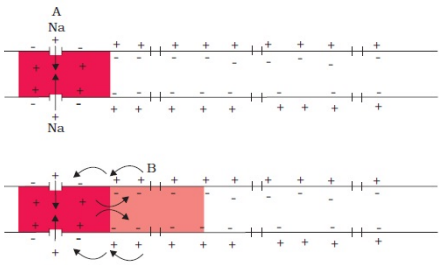
Examine the following diagram and answer the following questions:

Image
i. What is the diagram representing?
ii. When point A becomes permeable to Na¹, what change occurs in the polarity of the membrane.
iii. What is the potential difference at point A called ?
Write short note on the following, Coronary Artery Disease.
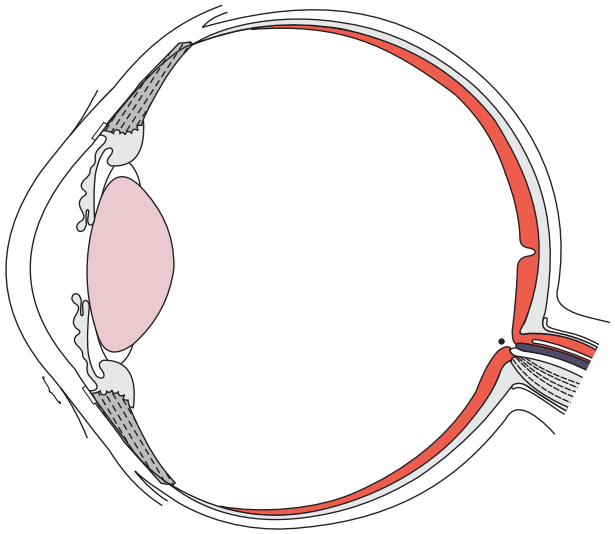
Label the following parts in the given diagram using arrow.
  1. Aqueous chamber.
  2. Cornea.
  3. Lens.
  4. Retina.
  5. Vitreous chamber.
  6. Blind spot.
​​​​​​​