Question
What is the value of $(1+\tan^2\theta)(1-\sin\theta)(1+\sin\theta)?$

Answer

$(1+\tan^2\theta)(1-\sin\theta)(1+\sin\theta)$
$=(1+\tan^2\theta)\{(1-\sin\theta)(1+\sin\theta)\}$
$=(1+\tan^2\theta)(1-\sin^2\theta)$
We know that,
$\sec^2\theta-\tan^2\theta=1$
$\Rightarrow\ \sec^2\theta=1+\tan^2\theta,$
$\sin^2\theta+\cos^2\theta=1$
$\Rightarrow\ \cos^2\theta=1-\sin^2\theta$
Therefore,
$(1+\tan^2\theta)(1-\sin\theta)(1+\sin\theta)=\sec^2\theta\times\cos^2\theta$
$=\frac{1}{\cos^2\theta}\times\cos^2\theta$
$=1$

Need a full question paper?

Generate a complete, print-ready paper with questions like this in minutes — across 16+ boards, with answer keys.

Start Generating Free

Similar questions

ΔMNT ~ ΔQRS. Length of altitude drawn from point T is 5 and length of altitude drawn from point S is 9. Find the ratio $\frac{ A (\Delta MNT )}{ A (\Delta QRS )}$
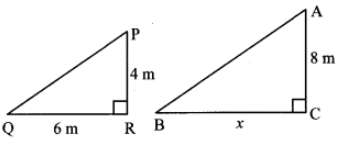
As shown in the adjoining figure, two poles of height 8 m and 4 m are perpendicular to the ground. If the length of shadow of smaller pole due to sunlight is 6 m, then how long will be the shadow of the bigger pole at the same time?
Image
If f(x) is a polynomial such that f(a) f(b) < 0, then what is the number of zeros lying between a and b?
Write sample space ‘S’ and number of sample point n(S) for each of the following experiments. Also write events A, B, C in the set form and write n(A), n(B), n(C).
One coin and one die are thrown simultaneously.
Condition for event A : To get head and an odd number.
Condition for event B : To get a head or tail and an even number.
Condition for event C : Number on the upper face is greater than 7 and tail on the coin.
The given sequence is AP or not ? If they are A.P. find the common difference.
$0, – 4, – 8, – 12, . . .$
Very-Short and Short-Answer Questions:
If $\frac{2}{\text{x}}+\frac{3}{\text{y}}=\frac{9}{\text{xy}}$ and $\frac{4}{\text{x}}+\frac{9}{ \text{y}}=\frac{21}{\text{xy}},$ find the values of x and y.
Write an A.P. whose first term is a and common difference is d in each of the following.
$a=-7, d=\frac{1}{2}$
Find first four terms of the sequence $t_n=n+2$
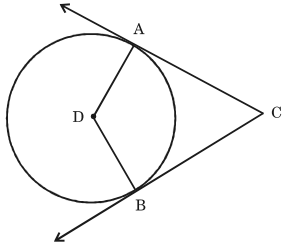
In the following figure, circle with centre D touches the sides of $\angle ACB$ at A and B. If $\angle ACB=52^{\circ}$, find measure of $\angle ADB$.
Image
$66$ cubic cm of silver is drawn into a wire $1mm$ in diameter. Calculate the length of the wire in metres.