MCQ
What is the value of $ \sin-1(\sin 6)?$
  • A
    $-2\pi - 6$
  • B
    $2\pi + 6$
  • either $-2\pi + 6$ or $2\pi + 6$
  • D
    $2\pi - 6$

Answer

Correct option: C.
either $-2\pi + 6$ or $2\pi + 6$
We know that $\sin(\text{x}) = \sin(2\text{A}^ * \pi + \text{x})$
 where $A$ can be positive or negative integer.
If $A$ is $-1,$ then $ \sin(6) = \sin(-2\pi + 6);$
If $A$ is $1,$ then $ \sin(6) = \sin(2\pi + 6).$

Need a full question paper?

Generate a complete, print-ready paper with questions like this in minutes — across 16+ boards, with answer keys.

Start Generating Free

Similar questions

A point $P$ lies on the line segment joining the points $(-1, 3, 2)$ and $(5, 0, 6).$ If $x-$coordinate of $P$ is $2,$ then its $z-$coordinate is:
The maximum value of $Z = 4x + 3y$ subjected to the constraints $3x + 2y \geq 160, 5x + 2y \geq 200, x + 2y \geq 80, x, y \geq 0$ is :
If a matrix $A$ is both symmetric and skewsymmetric, then
Statement $- 1:$ The function $x^2 (e^x + e^{-x})$ is increasing for all $x > 0.$

Statement $-2:$ The functions $x^2e^x$ and $x^2e^{-x}$ are increasing for all $x > 0$ and the sum of two increasing functions in any interval $(a, b)$ is an increasing function in $(a, b).$
If $\text{A}=\begin{bmatrix}5&\text{x}\\\text{y}&0\end{bmatrix}$ and $A = A^T,$ then:
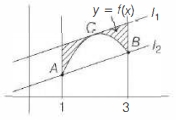
The following figure shows the graph of a continuous function $y=f(x)$ on the interval $[1,3]$. The points $A, B, C$ have coordinates $(1,1),(3,2),(2,3)$ respectively, and the lines $l_1$ and $l_2$ are parallel, with $l_1$ being tangent to the curve at $C$. If the area under the graph of $y=f(x)$ from $x=1$ to $x=3$ is $4$ sq units, then the area of the shaded region is
Let $A$ be a nonsingular square matrix of order $3 \times 3$. Then $|adj. A|$ is equal to:
Consider the differential equation $\frac{{dy}}{{dx}} = \frac{{{y^3}}}{{2(x{y^2} - {x^2})}}$

Statement $-1:$ The substitution $z = y^2$ transforms the above equation into a first order homogenous differential equation.

Statement $-2:$ The solution of this differential equation is ${y^2}{e^{ - {y^2}/x}} = C$.

he two curves $x^3 - 3xy^2 + 2 = 0$ and $3x^2y - y^3 - 2 = 0$ intersect at an angle of:
The distance of point $(1, 2, 3)$ from origin is