Question
What is Trade Discount? Give an example.

Answer

Trade Discount Trade Discount is a discount allowed by the seller on purchase of goods in large quantity. It is normally allowed by the seller to the purchaser who further sells goods to the consumer. It is deducted in the invoice from sale price and is not recorded in the books of account. Sale is recorded at the net value, i.e., sale price less trade discount For example, Amit sells goods to Vikas of ₹ 10,000 allowing him trade discount of 20%. The invoice will be prepared for net amount ₹ 8,000, i.e., after trade discount. Amit will pass following Journal entry in his books of account:Images.

Need a full question paper?

Generate a complete, print-ready paper with questions like this in minutes — across 16+ boards, with answer keys.

Start Generating Free

Similar questions

What is Noting of a bill of exchange.
Enter the following transactions in the Journal of Ganesh Bros.:
2017
 
March 3
Sold goods to Dev
1,00,000
March 5
Received from Dev in full settlement of his account
98,000
March 6
Sold goods to Manmohan
80,000
March 8
Manmohan returned goods
1,000
March 15
Received from Manmohan in full settlement of his account
78,200
March 16 Received cash from Ram and 19,500
Discount allowed 500
March 20 Paid cash to Pawan and 4,700
Discount received from him 300
March 25
Sold goods to Varun of the list price of 25,000 at 20% trade discount
 
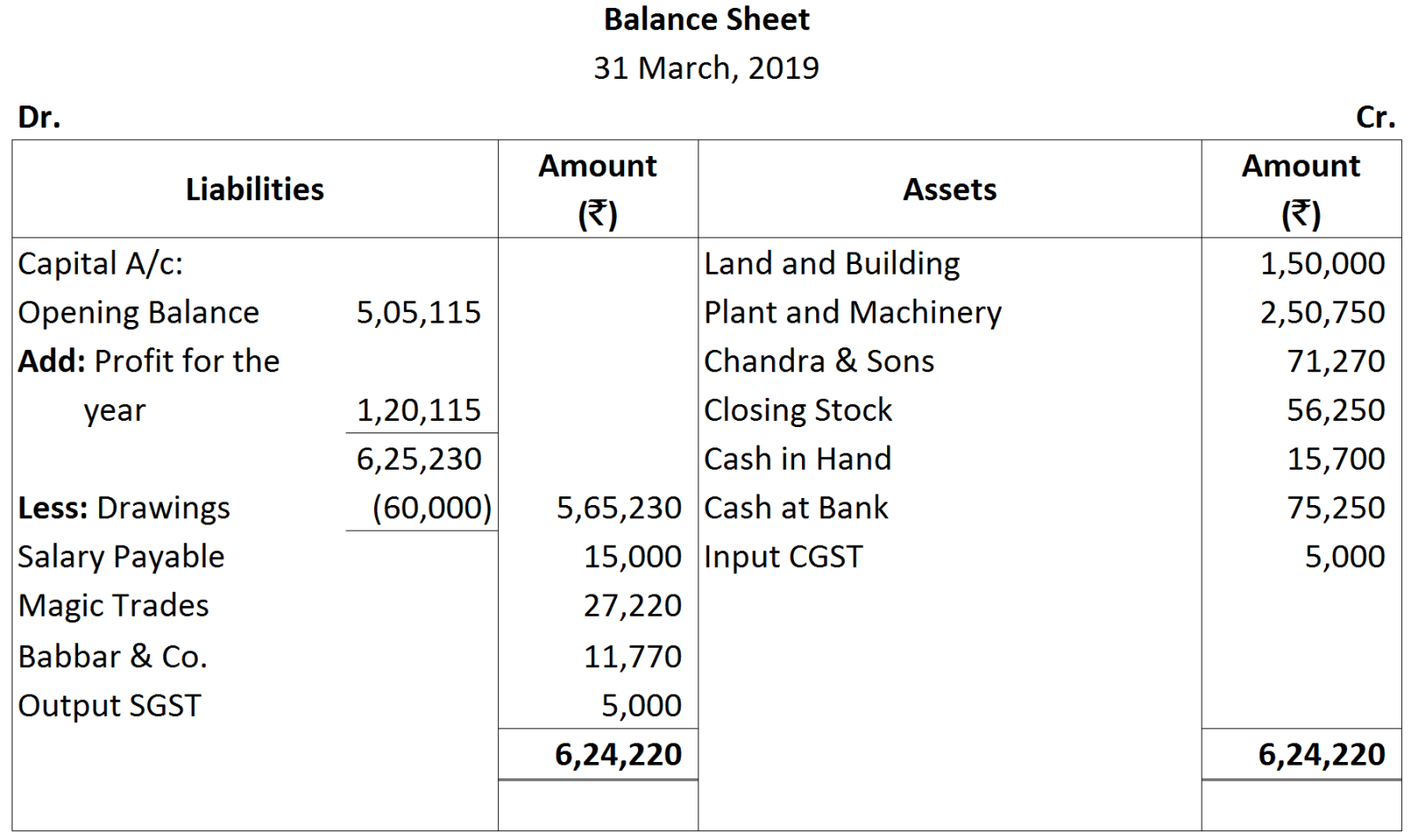
Pass the Opening Entry from the following Balance Sheet as at 31st March, 2019 of Vikas:
Cash Basis of Accounting is not a better basis for depicting the correct financial position of an enterprise. Do you agree? Give reasons in support of your answer.
Show the accounting equation on the basis of the following transactions and present a Balance Sheet of the last new equation balance:
    (₹)
i. Mohan commenced business with 70,000
ii. Purchased goods on Credit 14,000
iii. Withdrew for private use 1,700
iv. Purchased goods for Cash 10,000
v. Paid wages 300
vi. Paid to Creditors 10,000
vii. Sold goods on Credit at par 15,000
viii. Sold goods for Cash (cost price was ₹ 3,000) 4,000
ix. Purchased furniture for cash 500
Why should a business follow the consistency Concept?
Enter the following transactions in the Journal of Manohar Lal & Sons:
2019
 
Jan. 6
Sold goods for cash
36,000
Jan. 8
Sold goods to Hari
30,000
Jan. 14
Received cash from Hari
18,000
Jan. 26 Received Commission
750
Jan. 27
Paid Salary to Gopal
1,200
Jan. 28
Received cash from Hari
12,000
Jan. 29
Withdrew cash from office for personal use
4,000
Jan. 30
Wages paid
7,200
Jan. 30 Bought Machinery for Cash 8,000
Pass Journal Entries for the following transactions:
  1. Provide depreciation on Furniture ₹ 500 and on Machinery ₹ 2,000.
  2. Received cash ₹ 1,000 for bad-debts written off last year.
  3. Ajay Singh was declared bankrupt. He owed ₹ 2,500 to us. Nothing could be recovered from his estate.
  4. ₹ 20,000 for wages and ₹ 4,000 for salaries are outstanding.
  5. Purchased furniture for ₹ 6,000 for the proprietor and paid the amount by cheque.
  6. Provide 9% interest on capital amounting to ₹ 2,00,000.
  7. Charge interest on drawings ₹ 1,000.
On 1st April, 2019, the position of Rahman was as follows: Cash-in Hand ₹ 11,200; Cash at bank ₹ 2,57,600; Bills Receivable ₹ 68,800; Jai Ram (Dr.) ₹ 16,000; Ram Kumar (Dr.) ₹ 48,080; Office Furniture ₹ 52,800; Stock-in-Trade ₹ 4,16,000; Doulat Ram (Cr.) ₹ 1,74,720, Hari Ram (Cr.) ₹ 2,16,960; Bills Payable ₹ 80,000. What was the amount of capital of Rahman on that date? Pass the Journal entry to Open his books.
Mr. Abhinav Kumar, a homeopath doctor in practice has been advised by his Accountant to maintain his accounts on Accrual Basis instead of the presently followed Cash Basis of Accounting. Do you agree with the advice of the Accountant? Give reasons.