Question
What is transgenic animals? How it is useful for man kind?

Answer

→ Animals that have had their DNA manipulated to possess and express an extra (foreign) gene are known as transgenic animals.
→ Transgenic rats, rabbits, pigs, sheep, cows and fish have been produced, although over 95 per cent of all existing transgenic animals are mice.
(i) Normal physiology and development :
→ Transgenic animals can be specifically designed to allow the study of how genes are regulated, and how they affect the normal functions of the body and its development,
→ e.g., study of complex factors involved in growth such as insulin-like growth factor. By introducing genes from other species that alter the formation of this factor and studying the biological effects that result, information is obtained about the biological role of the factor in the body.
(ii) Study of disease :
→ Many transgenic animals are designed to increase our understanding of how genes contribute to the development of disease.
→ These are specially made to serve as models for human diseases so that investigation of new treatments for diseases is made possible.
→ Today transgenic models exist for many human diseases such as cancer cystic fibrosis. rheumatoid arthritis and Alzheimer's.
(iii) Biological products :
→ Medicines required to treat certain human diseases can contain biological products but such products are often expensive to make.
→ Transgenic animals that produce useful biological products can be created by the introduction of the portion of DNA (of genes) which codes for a particular product.
Examples :
→ human protein ($\alpha$ -1-antitrypsin) used to treat emphysema.
→ Similar attempts are being made for treatment of phenylketonuria (PKU) and cystic fibrosis.
→ In 1997, the first transgenic cow, Rosie, produced human protein-enriched milk (2.4 grams per litre). The milk contained the human a lactalbumin and was nutritionally a more balanced product for human babies than natural cow-milk.
(iv) Vaccine safety :
→ Transgenic mice are being developed for use intesting the safety of vaccines before they are used on humans.
→ Transgenic mice are being used to test the safety of the polio vaccine.
If successful and found to be reliable, they could replace the use of monkeys to test the safety of batches of the vaccine.
(v) Chemical safety testing :
→ This is known as toxicity/safety testing.
→ The procedure is the same as that used for testing toxicity of drugs.
→ Transgenic animals are made that carry genes which make them more sensitive to toxic substances than non-transgenic animals.
→ They are then exposed to the toxic substances and the effects studied.
→ Toxicity testing in such animals will allow us to obtain results in less time.

Need a full question paper?

Generate a complete, print-ready paper with questions like this in minutes — across 16+ boards, with answer keys.
Start Generating Free

Similar questions

Read the following and answer any four questions from (i) to (v) given below:

Pollen-pistil interaction is the group of events that occur from the time of pollen deposition over the stigma to the time of pollen tube entry into ovule. It is a dynamic process which has checks at several places for promotion or inhibition of pollen growth. Pollen-pistil interaction is a safety measure to ensure that illegitimate crossings do not occur. Compatibility and incompatibility of the pollen-pistil is determined by special proteins. The compatible pollens are able to absorb water and nutrients from the surface of the stigma. They germinate and produce pollen tubes. Pollen tubes grow into the style. Their growth and path through the style are also determined by specific chemicals.

  1. Which of the following parts of gynoecium determines the compatible nature of pollen?
  1. Stigma.
  2. Style.
  3. Ovary.
  4. Thalamus.
  1. In Triforium, which type of self-incompatibility is found?
  1. Gametophytic self-incompatibility (GSI).
  2. Sporophytic self-incompatibility (SSI).
  3.  Both GSI and SSI.
  4. None of these.
  1. Select the incorrect statement.
  1. In Asteraceae, incompatibility is due to the genotype of the sporophytic stigmatic tissues.
  2. In members of Brassicaceae, incompatibility is due to the genotype of the pollen.
  3. Nature has imposed self-incompatibility to avoid highly homozygous individuals, which have a very low survival value.
  4. None of these.
  1. Which of the following are examples of self incompatibility?
  1. Tobacco.
  2. Potato.
  3. Crucifers.
  4. All of these.
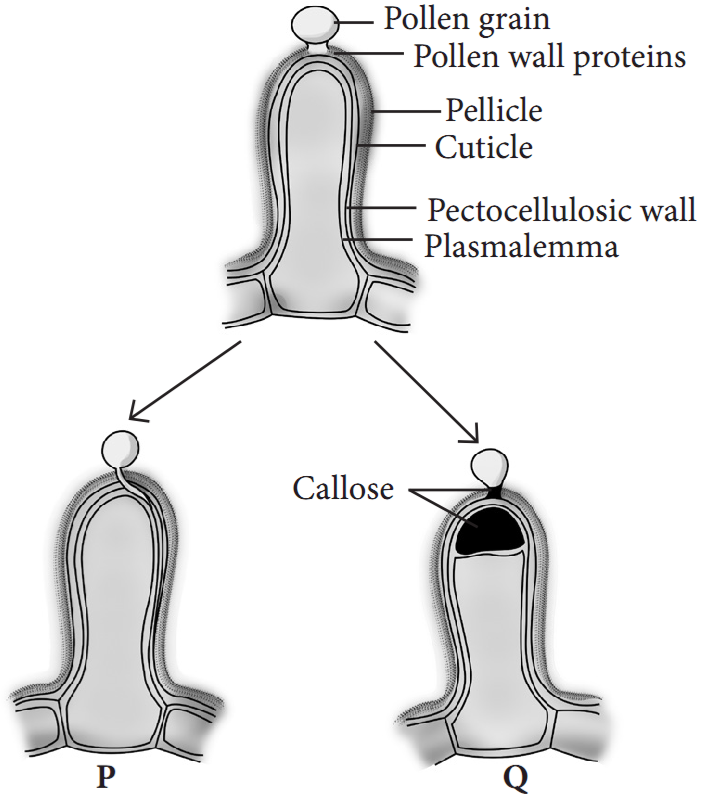
  1. Given figures show the pollen-stigma interaction, where pollen wall proteins are released onto the pellicle of stigmatic papillae, where a recognition reaction occurs.

Which of the following statements drawn from given figures is incorrect?
  1. P indicates compatible reaction in which the pollen tube penetrates the cuticle and grows down the papilla.
  2. Development of callose plug between the plasma membrane and pectocellulosic layer of stigmatic papillae results in the incompatibility reaction in Q.
  3. A callose plug, which appears at the tip of pollen in Q, is dissolved by callase enzyme secreted by stigma resulting in compatibility reaction.
  4. Deposition of callose can be employed as a reliable bioassay to detect compatibility or incompatibility reactions of pollen and stigma.
Read the following and answer any four questions from (i) to (v) given below:
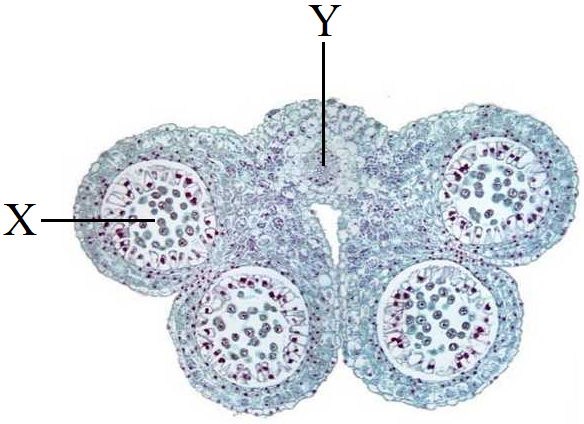
Many adaptations are found in flowers to achieve certain kind of pollination. The pollination achieved by insects is known as entomophily. The given diagram shows the cross-section of an anther of an insect pollinated flower.

  1. Which of the following is/ are the function(s) of structure Y?
  1. To carry waste products away from the anther.
  2. To supply oxygen to the cells of the anther.
  3. To transport food and mineral salts to the anther.
  4. To supply water to the anther.
  1. Conly.
  2. C and D only.
  3. A, B and D only.
  4. A, B, C and D.
  1. Which of the following most accurately describes the structures found in compartment X?
  1. They contain two haploid nuclei resulting from meiosis.
  2. They contain two haploid nuclei resulting from mitosis.
  3. They contain two haploid male gametes, resulting from mitosis.
  4. They contain a vegetative nucleus and pollen tube nucleus.
  1. Which of the following is a distinctive characteristic of insect-pollinated flower?
  1. All of them have nectar guides on their flowers.
  2. They produce sugary fruit.
  3. Their pollen grains tend to have rough surfaces.
  4. They produce abundant quantities of pollen to make up for pollen grains that might be removed by the wind.
  1. Which of the following are likely characteristics of the structures found in X and stamens of this plant?
S. No
Structure of X
Stamens
(a)
Abundant and light
Pendulous
(b)
Rough surfaces
Non-pendulous
(c)
Light and sticky
Pendulous
(d)
Coarse and sticky
Protrude outside the flower
  1. Spiny or sticky pollen grains and large, attractively coloured flowers are associated with:
  1. Hydrophily.
  2. Entomophily.
  3. Ornithophily.
  4. Anemophily.
Read the following and answer any four questions from (i) to (v) given below:

Discovery of penicillin by Alexander Fleming in 1928 marked the beginning of the remarkable era in medical field. Penicillin was the first antibiotic extracted from Penicillium notatum. Antibiotics are used to treat bacterial diseases. These can be broad spectrum which can kill diverse group of disease causing bacteria and narrow spectrum which is effective only against one group of pathogenic strain. Antibiotics can act as bactericides or bacteriostatic. Bactericidal antibiotics kill bacteria by - disruption of cell wall synthesis (e.g., penicillin, cephalosporin, etc.), inhibition of SOS ribosome function (e.g.; erythromycin), inhibition of 30S ribosome function (e.g., streptomycin, neomycin), inhibition of amino acid-tRNA binding to ribosome (e.g., tetracyline). etc. Bacteriostatic antibiotics do not kill the bacteria rather they restrict the growth of bacteria. Penicillin belongs to $\beta$-lactum group of antibiotics and it inhibits bacterial cell wall synthesis by binding and inactivating protein. It inhibits transpeptidation of reaction and blocks cross-linking of the cell wall. It is used to treat tonsilitis, sore throat, gonorrhoea, rheumatic fever and some pneumonia types.

  1. The first antibiotic was extracted from a:
  1. Lichen.
  2. Fungus.
  3. Eubacteria.
  4. Acti-nomycetes.
  1. Which of the following kills bacteria by interfering SOS ribosome function?
  1. Cephalosporin.
  2. Erythromycin.
  3. Streptomycin.
  4. Neomycin.
  1. $\beta$-lactum group of antibiotics kill the bacterial pathogen by:
  1. Disruption of plasma membrane.
  2. Inhibition of translation of mRNA.
  3. Inhibition of translation of mRNA
  4. Inhibition of transcription of mRNA.
  1. Penicillin is not used to treat.
  1. Pneumonia.
  2. Tonsilitis.
  3. Rheumatic fever.
  4. Candidiasis.
  1. Assertion: Cephalosporins act by disruption of bacterial cell wall synthesis mechanism.

Reason: Cephalosporins are bacteriostatic antibiotics.

  1. Both assertion and reason are true and reason is the correct explanation of assertion.
  2. Both assertion and reason are true but reason is not the correct explanation of assertion.
  3. Assertion is true but reason is false.
  4. Both assertion and reason are false.
Read the following and answer any four questions from (i) to (v) given below:
Translation is the process of polymerisation of amino acids to form a polypeptide. The order and sequence of amino acids are defined by the sequence bases in the mRNA. The amino acids are joined by a bond called peptide bond. Ribosome is the site of protein synthesis.
  1. Which ion is essential for association of both units of ribosome at the time of protein formation?
  1. Mg2+
  2. Mn2+
  3. CI-
  4. Ca2+
  1. During translation, how many initiation factors are required in eukaryotes for initiation reactions?
  1. 3
  2. 6
  3. 7
  4. 9
  1. Which part of mRNA contains untranslated regions (UTR)?
  1. 3' end
  2. 5' end
  3. Either 3' or 5' end
  4. Both 5' end and 3' end
  1. Name the enzyme that helps in combining amino acid to its particular tRNA?
  1. Activating enzyme
  2. Amino-acyl tRNA-synthetas
  3. PeptidyI transferase
  4. Both (a) and (b)
  1. From the given list, select the translation machinery.
  1. mRNA
  2. Ribosomes
  3. Amino acids
  4. tRNAs
  5. Peptidyl transferase
  6. Amino acyl tRNA synthetase
  7. Pyrophosphatase
  1. (1), (2), (3), (4) and (6)
  2. (1), (2), (3), (4) and (5)
  3. (1), (2), (3), (4), (5) and (6)
  4. (1), (2), (3), (4), (5), (6) and (7)
For food related services, granting patent for transgenic organisms is becoming complicated. Explain with example.
Describe the process of DNA Fingerprinting in detail.
Read the following and answer any four questions from (i) to (v) given below:
IUCN maintains a Red Data Book or Red List which is a catalogue of taxa facing risk of extinction. The IUCN Red List (2004) documents the extinction of 784 species in the last 500 years. Some examples of recent extinctions include the dodo, quagga, thylacine and Steller's sea cow. The last twenty years alone have witnessed the disappearance of 27 species. Red List has eight categories of species.
  1. Dodo, an extinct taxon, belongs to which country?
  1. Mauritius
  2. Africa
  3. Australia
  4. Russia
  1. To which of the following categories of IUCN, Berberis nilghiriensis belongs?
  1. Extinct.
  2. Extinct in wild.
  3. Endangered.
  4. Critically endangered.
  1. Steller's sea cow and passenger pigeon became extinct due to:
  1. Alien species invasion.
  2. Over-exploitation.
  3. Coextinctions.
  4. Intensive agriculture.
  1. Bali, Javan and Caspian are:
  1. Species of tiger.
  2. Species of cheetah.
  3. Subspecies of cheetah.
  4. Subspecies of tiger.
  1. Select the correct term for the following definitions (i, ii, iii, iv).
  • The taxon is liable to become extinct if not allowed to realise its full biotic potential by providing protection from exotic species/ human exploitation/habitat deterioration/depletion of food.
  • The taxon has been completely eliminated or died out from earth, e.g., Dodo.
  • The taxon is facing a high risk of extinction in the wild in the near future due to decrease in its habitat, excessive predation or poaching.
  • They are species with naturally small populations, either localised or thinly scattered, which are always at risk from pests/ pathogens/ predators/ exotic species.
 
(i)
(ii)
(iii)
(iv)
(a)
Threatened
Extinct
Endangered
Rare
(b)
Endangered
Extinct
Threatened
Rare
(c)
Extinct
Rare
Threatened
Endangered
(d)
Threatened
Extinct
Rare
Endangered
Read the following and answer any four questions from (i) to (v) given below:

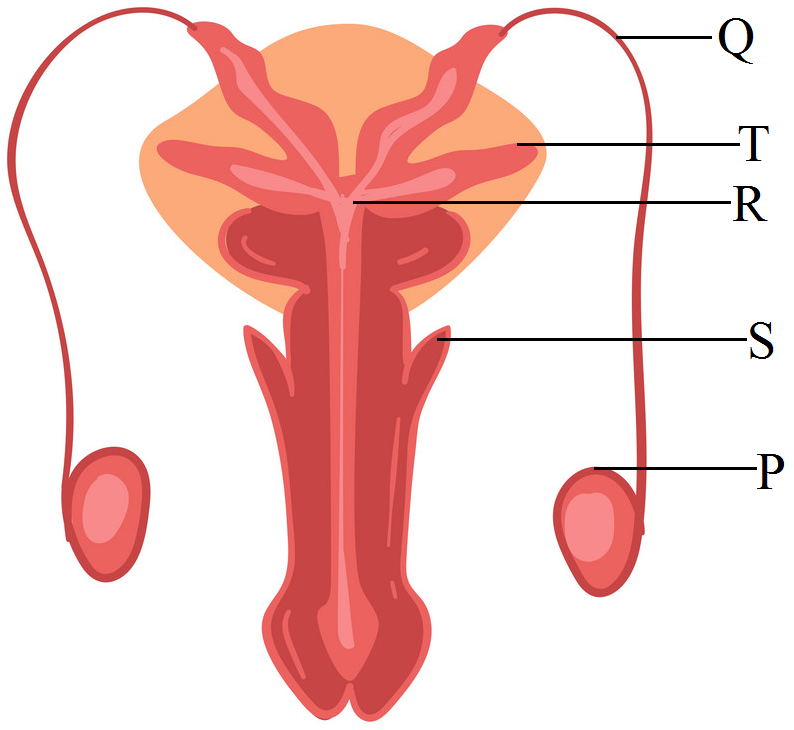
Human male reproductive system comprises of a pair of testes, primary sex organs associated with formation of gametes and production of sex hormone. Study the given figure of human male reproductive system and answer the following questions.

  1. Which of the following is correct for labelled part P?
  1. P is rete testis which transports sperms to outside.
  2. P is epididymis which secretes fluid that nourish the sperms.
  3. P is epididymis that carry sperms and secretion of seminal vesicles.
  4. P is rete testis, which lies along inner side of each testis and stores the sperms.
  1. Identify the correctly matched pair.
  1. Q - Vasa efferentia.
  2. R - Ejaculatory duct.
  3. S - Seminal vesicle.
  4. T - Cowper's gland.
  1. Which statement is incorrect for Q?
  1. It carries spermatozoa from epididymis to ejaculatory duct.
  2. Q are only 2 in number.
  3. It arises from rete testis.
  4. It constitutes male sex accessory duct.
  1. Which structure passes through the prostate gland and carries sperms and secretion of seminal vesicle?
  1. P.
  2. T.
  3. S.
  4. R.
  1. Assertion: Mucus present in secretion of bulbourethral gland decreases the number of sperms damaged during ejaculation.

Reason: Mucus lubricates the end of penis and lining of the urethra.

  1. Both assertion and reason are true, and reason is the correct explanation of assertion.
  2. Both assertion and reason are true, but reason is not the correct explanation of assertion.
  3. Assertion is true, but reason is false.
  4. Both assertion and reason are false.
The size of a population for any species is not a static parameter. Explain.###Explain population growth###Explain in brief - population growth.
Discuss the important measures that are useful in preventing and controlling the use of alcohol and drugs in youth.