Question
What is weak electrolyte? Explain relation between concentration of weak electrolyte and molar conductivity.
Answer

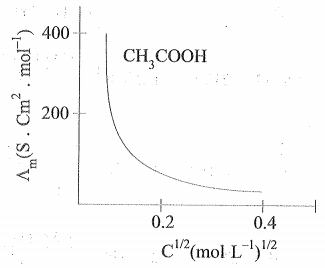
→ "Electrolyte which is incompletely ionized in its aqueous solution are known as weak electrolyte.
→" Weak electrolytes like acetic acid have lower degree of dissociation at higher concentrations and hence for such electrolytes, the change in $\hat{m}_{ m }$ with dilution is due to increase in the degree of dissociation and consequently the number of ions in total volume of solution that contains 1 mol of electrolyte.
→ In such cases $\wedge_{ m }$ increases steeply on dilution especially near lower concentrations. Therefor $\wedge_{ m }^0$ cannot be obtained by extra polation of $\wedge_{ m }^0$ zero concentration.
→ At infinite dilution (i.e. concentration $c \rightarrow$ zero electrolyte dissociates completely $(\alpha=1)$, but such low concentration the conductivity of the solution is so low that it cannot be measured accurately.
→ Therefore, $\wedge_{ m }^0$ for weak electrolytes is obtained by using Kohlrausch law of independent migration of ions.
Image
→ At any concentration c , if a is the degree of dissociation then it can be approximated to the ratio of molar conductivity $\wedge_{ m }$ at the concentration c to limiting molar conductivity, $\wedge_{ m }^0$ Thus we have :
$\begin{aligned} \alpha & =\frac{\Lambda_{ m }}{\Lambda_{ m }^0} \\ k _{ a } & =\frac{ c \alpha^2}{1-\alpha}=\frac{ c \Lambda_{ m }^2}{\Lambda_{ m }^{02}\left(1-\frac{\Lambda_{ m }}{\Lambda_{ m }^0}\right)}=\frac{ c \Lambda_{ m }^2}{\Lambda_{ m }^0 \Lambda_{ m }^0-\Lambda_{ m }}\end{aligned}$

Need a full question paper?

Generate a complete, print-ready paper with questions like this in minutes — across 16+ boards, with answer keys.

Start Generating Free

Similar questions

Thermodynamic feasibility of the reaction alone cannot decide the rate of the reaction. Explain with the help of one example.
The electrical resistance of a column of 0.05 M KOH solution of diameter 1 cm and length 45·5 cm is 4.55 $\times$ 103 ohm. Calculate its molar conductivity.
  1. What is a ligand? Give an example of a bidentate ligand.
  2. Explain as to how the two complexes of nickel, [Ni(CN)4]2– and Ni(CO)4, have different structures but do not differ in their magnetic behaviour. (Ni = 28).
Write the reactions involved when D-glucose is treated with the following reagents:
  1. Br2 water
  2. H2N-OH
  3. (CH3CO)2O
The reaction, N2 (g) + O2 (g) $\rightleftharpoons$ 2NO(g) contributes to air pollution whenever a fuel is burnt in air at a high temperature. At 1500K, equilibrium constantKfor it is 1.0 x 10⁻⁵. Suppose in a case [N2] = 0.80 mol L–1 and [O2] = 0.20 mol L–1 before any reaction occurs. Calculate the equilibrium concentrations of the reactants and the product after the mixture has been heated to 1500 K.
  1. The cell in which the following reaction occurs:

2 Fe3+ (aq) + 2 I- (aq) $\longrightarrow$ 2 Fe2+ (aq) + I2(s)

has $\text{E}^0_{\text{cell}}$ = 0·236 V at 298 K. Calculate the standard Gibbs energy of the cell reaction. (Given : 1 F = 96,500 C mol-1)
  1. How many electrons flow through a metallic wire if a current of 0·5 A is passed for 2 hours? (Given : 1 F = 96,500 C mol-1)
How will you bring about the following conversions?
n-Propyl chloride to iso-propyl chloride.
Explain Halogenation, Nitration, Sulphonation and Friedel crafts reaction of chlorobenzene.
Complete the following chemical reaction equations:
$\text{MnO}^-_4(\text{aq})+\text{C}_2\text{O}^{2-}_4(\text{aq})+\text{H}^+(\text{aq})\xrightarrow{\ \ \ \ \ \ \ \ \ }$