Question
What is Wheatstone bridge? Explain its principle.

Answer

Image
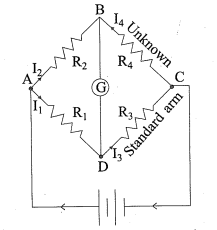
→The circuit shown in the figure is called the wheatstone bridge. It uses four resistors $R_1, R_2$, $R _3$ and $R _4$ out of them three resistors are known and one is unknown, wheatstone bridge is used to find the value of unknown resistance.
→As shown in the figure, across one pair of diagonally opposite points (A and C in the figure) a source is connected hence AC is called the battery arm.
→Between the other two vertices, B and D , a galvanomenter G is connected hence BD is called the galvanometer arm.
→When battery is connected, the currents flowing through the resistors $R_1, R_2, R_3$ and $R_4$ are $I_1$, $I _2, I _3$ and $I _4$ respectively.
→Here, there resistors are chosen in such a way that current flowing through galvanometer is zero $\left(I_g=0\right.$ ).
→When the current flowing through the galvanometer becomes zero, the bridge is said to be in balanced condition.
→From the figure, in balanced condition
$I _1= I _3 \text { and } I _2= I _4$
→Applying Kirchhoff's loop rule to closed loop
$\begin{array}{l}
A - D - B - A \\
- I _1 R _1+0+ I _2 R _2=0 \\
\therefore I _1 R _1= I _2 R _2
\end{array}$
→Applying similarly, for closed loop $C - B - D - C$
$\begin{aligned}
& I _4 R _4+0- I _3 R _3=0 \\
\therefore & I _3 R _3= I _4 R _4
\end{aligned}$
→Taking ratio of equation (1) and (2)
$\therefore \quad \frac{ I _1 R _1}{ I _3 R _3}=\frac{ I _2 R _2}{ I _4 R _4}$
But $I _1= I _3$ and $I _2= I _4$
$\therefore \frac{ R _1}{ R _3}=\frac{ R _2}{ R _4}$ OR $\frac{ R _1}{ R _2}=\frac{ R _3}{ R _4}$
→which is a condition for the whetstone bridge to be in balanced condition.
→If three resistors $R_1, R_2$ and $R _3$ are known then unknown resistence of $R_4$ is given by
$R _4= R _3 \cdot \frac{ R _2}{ R _1}$
→A practical device using this principle is called the meter bridge. 

Need a full question paper?

Generate a complete, print-ready paper with questions like this in minutes — across 16+ boards, with answer keys.
Start Generating Free

Similar questions

The current through a wire depends on time as $\text{i}=\text{i}_0+\alpha\text{t},$
Where $\text{i}_0=10\text{A}$ and $\alpha=4\text{A/ s}.$ Find the charge that crosses through a section of the wire in 10 seconds.
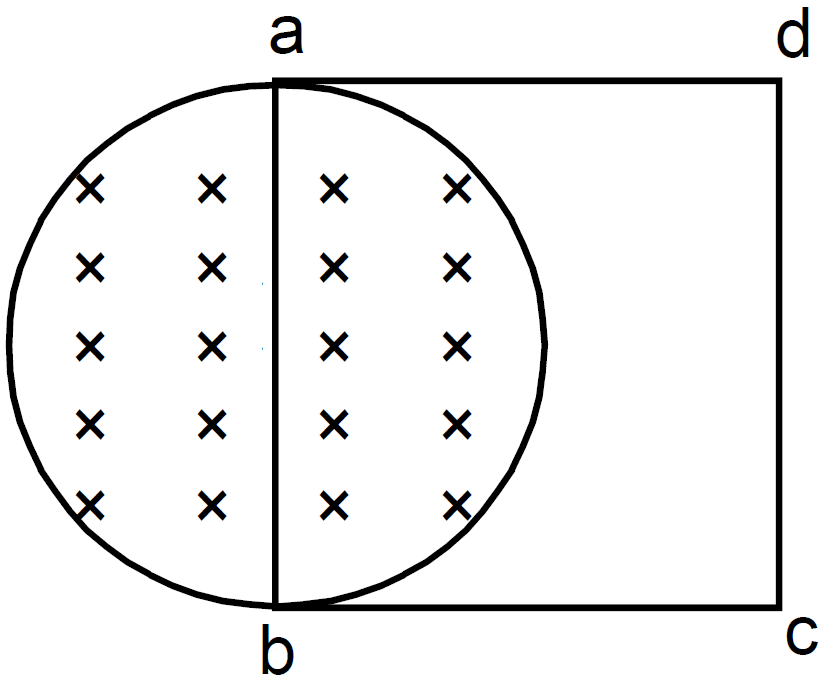
A uniform magnetic field B exists in a cylindrical region of radius 10cm as shown in figure. A uniform wire of length 80cm and resistance $4.0\Omega$ is bent into a square frame and is placed with one side along a diameter of the cylindrical region. If the magnetic field increases at a constant rate of 0.010T/s, find the current induced in the frame.

Two wires A and B of the same material and having same length, have their cross sectional areas in the ratio 1 : 6. What would be the ratio of heat produced in these wires when same voltage is applied across each?
Calculate the change in internal energy of a gas kept in a rigid container when 100J of heat is supplied to it.
The wavelength of a probe is roughly a measure of the size of a structure that it can probe in some detail. The quark structure of protons and neutrons appears at the minute length-scale of 10–15 m or less. This structure was first probed in early 1970’s using high energy electron beams produced by a linear accelerator at Stanford, USA. Guess what might have been the order of energy of these electron beams. (Rest mass energy of electron = 0.511 MeV.)
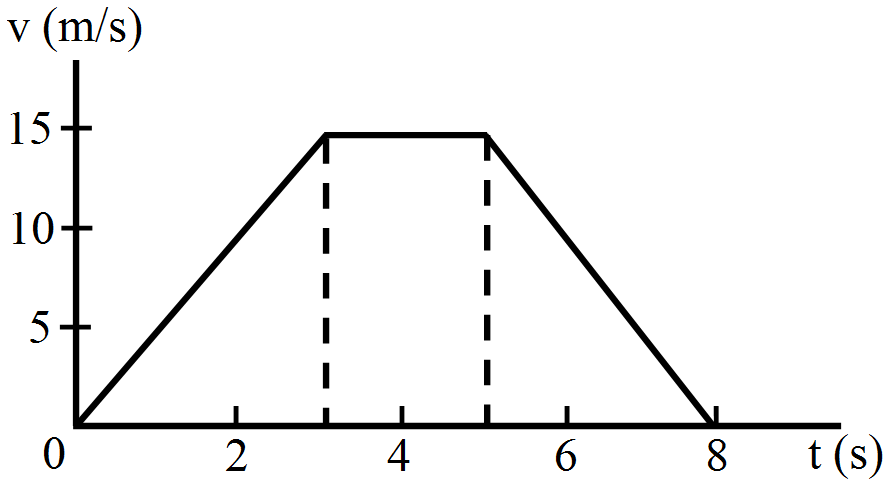
A particle of mass 50g moves on a straight line. The variation of speed with time is shown in figure. Find the force acting on the particle at t = 2, 4 and 6 seconds.

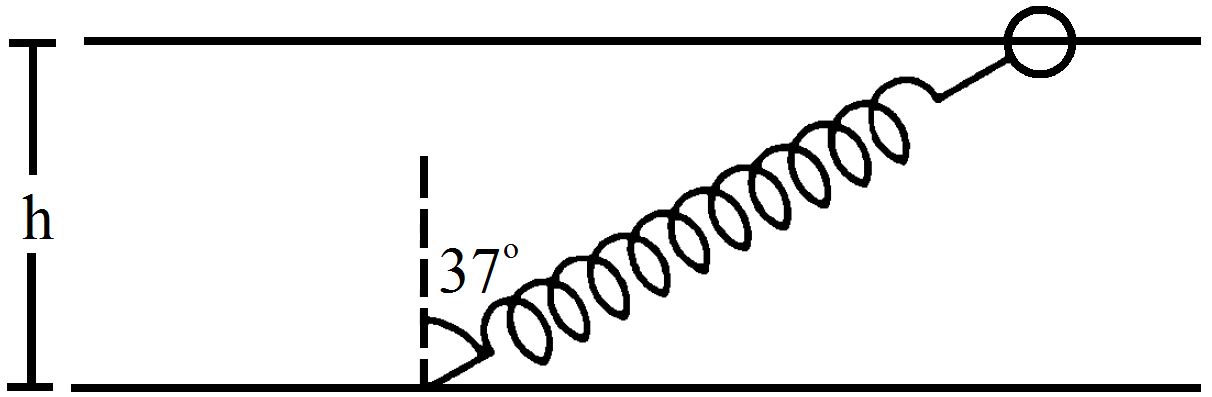
One end of a spring of natural length h and spring constant k is fixed at the ground and the other is fitted with a smooth ring of mass m which is allowed to slide on a horizontal rod fixed at a height h (figure). Initially, the spring makes an angle of 37° with the vertical when the system is released from rest. Find the speed of the ring when the spring becomes vertical.

An ideal battery sends a current of 5A in a resistor. When another resistor of value $10\Omega$ is connected in parallel, the current through the battery is increased to 6A. Find the resistance of the first resistor.
For a CE-transistor amplifier, the audio signal voltage across the collector resistance of 2 k$\Omega$ is 2 V. suppose the current amplification factor if the transistor is 100, find the input signal voltage and base current if the base resistance is 1 k$\Omega$.
  1. Draw a labelled ray diagram showing the formation of a final image by a compound microscope at least distance of distinct vision.
  2. The total magnification produced by a compound microscope is 20. The magnification produced by the eye piece is 5. The microscope is focussed on a-certain object. The distance between the objective and eyepiece is observed to be 14 cm. If least distance of distinct vision is 20 cm, calculate the focal length of the objective and the eye piece.