Question
What is 'Window Dressing'? Explain with the help of an example.

Answer

Window dressing is a technique used by companies and financial managers to manipulate financial statements and reports to show more favorable results for a period. Although window dressing is illegal or fraudulent, it is slightly dishonest and is usually done to mislead investors.Example of Window Dressing:
Let's assume that a company operates throughout the year with a negative balance in its general ledger account Cash, Checking Account. (At the bank, the checking account has a positive balance due to the time it takes for the company's checks to clear.) In order to avoid its December 31 balance sheet reporting a negative cash balance, the company decides to postpone issuing checks for vendors' invoices that should have been paid. The postponement allows its general ledger Cash account to temporarily have a positive amount. On January 2, the company will issue the postponed checks and will resume its normal practice of having a negative balance in its Cash account.

Need a full question paper?

Generate a complete, print-ready paper with questions like this in minutes — across 16+ boards, with answer keys.

Start Generating Free

Similar questions

On 1st April, 2014, Popular Ltd. issued 20,000; 10% Debentures of ₹ 100 each at a discount of 10% redeemable at par. Show the 'Discount on Issue of Debentures Account' if:
  1. Such debentures are redeemable after 4 years.
  2. Such debentures are redeemable by equal annual drawings in 4 years, starting from 31st March, 2015. Popular Ltd. follows financial year as its accounting year.
The current ratio of a company is 2 : 1. State which of the following would improve, reduce or not change the ratio:
  1. Repayment of a current liability.
  2. Purchasing goods on credit.
  3. Sale of motor vehicle at a profit of 10%.
  4. Sale of goods at a profit of 10%.
  5. Payment of dividend payable.
  6. Repayment of Long tern Borrowings
K Limited has been registered with an authorised capital of ₹ 20,00,000 divided into 20,000 shares of ₹ 100 each of which 10,000 shares were offered for public subscription at a premium of ₹ 5 per, share payable is under.
 
On application
30
On allotment
25 (including premium)
On first call
20
On final call
30
Applications were received for 18,000 shares, of which applications tor 3,000 shares were rejected outright; the rest of the applications were allotted 10,000 shares pro-rata basis. Excess application money was transferred to allotment.
All the moneys were duly received except from Sundar, holder of 200 shares, who, failed to pay allotment and first call money. His shares were later forfeited, and re-issued to Shyam at ₹ 60 per share, ₹ 70 paid up. Final Call has not been made. Pass necessary Cash Book and Journal entries in the books of K Limited.
Calculate any three of the following ratios with the help of the following information:
  1. Operating Ratio.
  2. Current Ratio.
  3. Gross Profit Ratio.
  4. Inventory Turnover Ratio.
  5. Debt Equity Ratio
Information: Equity Share Capital ₹ 5,00,000; 12% Debentures ₹ 6,00,000; 9% Preference Share Capital ₹ 3,00,000; General Reserve ₹ 1,00,000; Revenue from Operations , ₹ 10,00,000; Opening Inventory ₹ 80,000; Purchases ₹ 6,00,000; Wages , 1,00,000; Closing Inventory ₹ 1,00,000; Selling and distribution expenses ₹ 20,000; Other current assets ₹ 5,00,000 and Current liabilities ₹ 3,00,000.
Take a few imaginary figures and prepare a Comparative Statement of Profit & Loss for two years.
The ratio of Current Assets (₹ 9,00,000) to Current Liabilities is 1.5 : 1. The accountant of this firm is interested in maintaining a Current Ratio of 2 : 1 by paying some part of Current Liabilities. You are required to suggest him the amount of Current Liabilities which must be paid for this purpose.
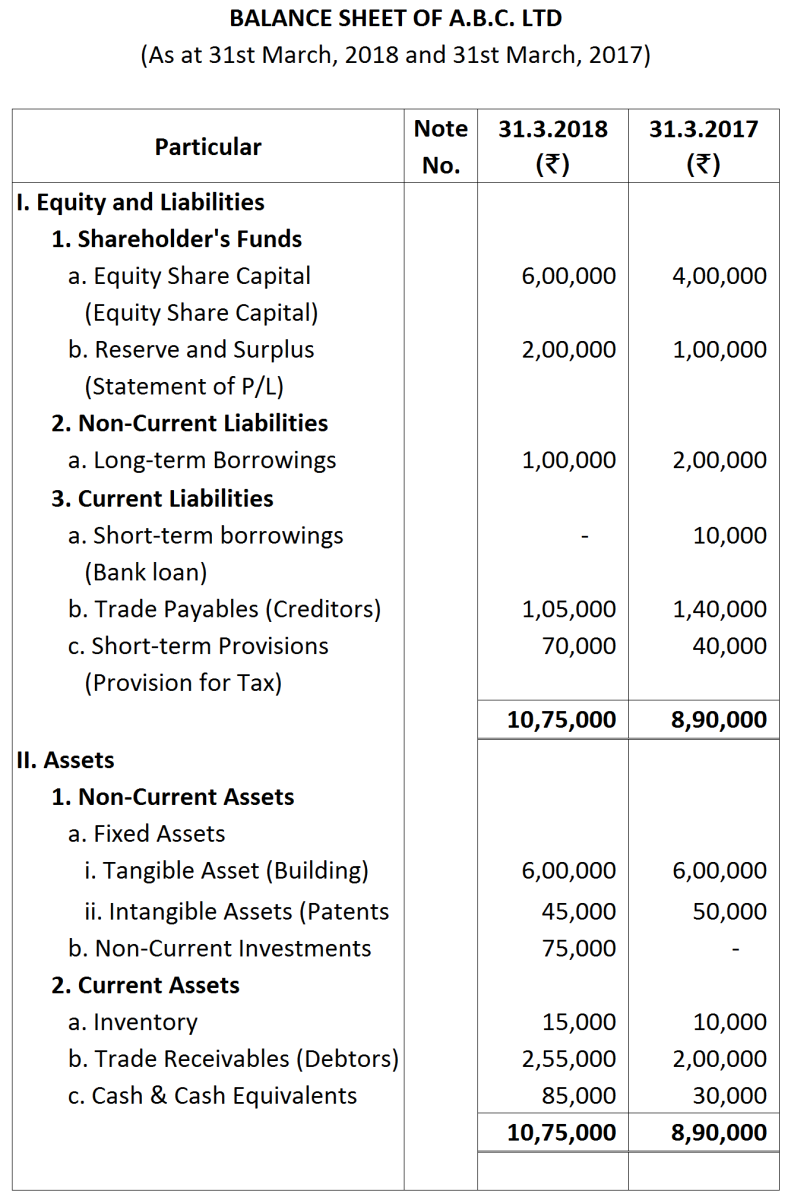
You are required to prepare a Cash Flow Statement (as per AS-3) for the year 2017-18 from the following Balance Sheets:

Additional Information:
During the year 2017-18:
  1. Building costing ₹ 75,000 was purchased
  2. An old building, the book value of which was ₹ 63,000., was sold at a loss of ₹ 5,000.
  3. Tax provided during the year was ₹ 80,000.
  4. Proposed Dividend for the year ended 31st March, 2017 was 20% and for the year ended 31st March, 2018 was 10%.
Alfa Ltd. invited applications for issuing 75,000 equity shares of ₹ 10 each. The amount was payable as follows:
On application and allotment - ₹ 4 per share,
On first Call - ₹ 3 per share,
On second and final Call - balance.
Applications for 1,00,000 shares were received. Shares were allotted to all the applicants on pro rata basis and excess money received with applications was transferred towards sums due on first call. Vibha who was allotted 750 shares failed to pay the first call. Her shares were immediately forfeited. Afterwards the second call was made. The amount due on second call was also received except on 1,000 shares applied by Monika. Her shares were also forfeited. All the forefited shares were reissued to Mohit for ₹ 9,000 as fully paid-up.
Pass necessary journal entries in the Books of Alfa Ltd. for the above transactions.
The Hindustan Manufacturing Ltd. had a total subscribed capital of ₹ 10,00,000 in Equity Shares of ₹ 10 each of which ₹ 7.50 were called-up. A final call of ₹ 2.50 was made and all amount paid except two calls of ₹ 2.50 each in respect of 100 shares held by D. These shares were forfeited and reissued at ₹ 8 per share.
Pass necessary journal entries (including that of cash) to record the transactions of final call, forfeiture of shares and reissue of forfeited shares. Also, prepare the Balance Sheet of the company.
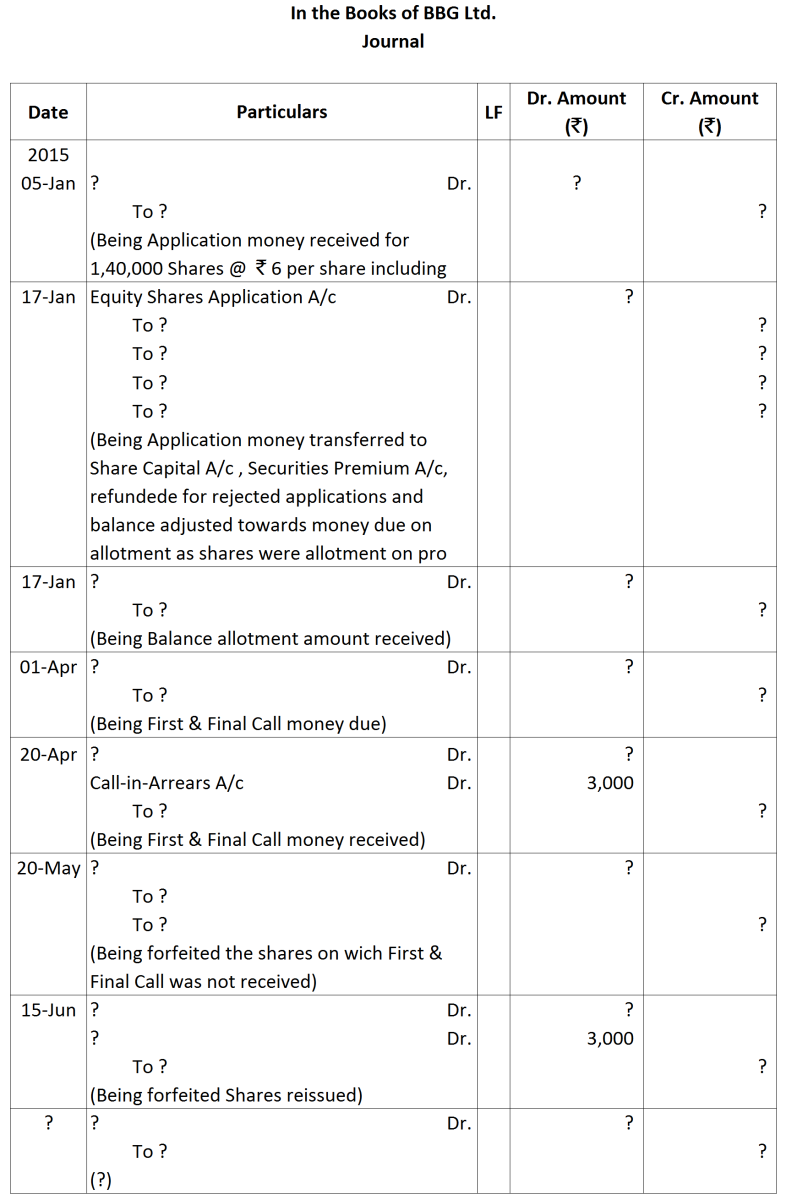
BBG Ltd. hsd issued 1,00,000 equity of ₹ 10 each at a premium of ₹ 3 per share payable with application money. While passing the Journal entries related to the issue, some blanks are left. You are required to complete these blanks.