MCQ
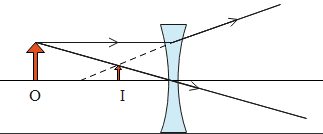
What kind of image is obtained always for concave lens?
- AVirtual, Erect and Diminished
- BReal, Erect and Large
- CReal, Erect and Diminished
- DAll of these
What kind of image is obtained always for concave lens?
Explanation:
As can be seen in image, Virtual, Erect and Diminished image is obtained always for concave lens.
Generate a complete, print-ready paper with questions like this in minutes — across 16+ boards, with answer keys.
Light takes 8 min 20 sec to reach from sun on the earth. If the whole atmosphere is filled with water, the light will take the time (a
|
(a) 8 min 20 sec |
(b) 8 min |
(c) 6 min 11 sec |
(d) 11 min 6 sec |
Electric charges of +10μC, + 5μC, -3μC and +8 μC are placed at the corners of a square of side  m. the potential at the centre of the square is
|
(a) 1.8 V |
(b) |
(c) 1.8 |
(d) 1.8 |
A straight wire of diameter 0.5 mm carrying a current of 1 A is replaced by another wire of 1 mm diameter carrying the same current. The strength of magnetic field far away is
|
(a) Twice the earlier value |
(b) Half of the earlier value |
|
(c) Quarter of its earlier value |
(d) Unchanged |
Assertion : Silicon is preferred over germanium for making semiconductor devices.
Reason : The energy gap for germanium is more than the energy gap of silicon.
|
(a) If both assertion and reason are true and the reason is the correct explanation of the assertion. |
|
(b) If both assertion and reason are true but reason is not the correct explanation of the assertion. |
|
(c) If assertion is true but reason is false. |
|
(d) If the assertion and reason both are false. |