MCQ
What makes a lemon sour
- ATartaric acid
- BOxalic acid
- ✓Citric acid
- DHydrochloric acid
Generate a complete, print-ready paper with questions like this in minutes — across 16+ boards, with answer keys.
(nearest integer)
[Given : Molar mass of $\mathrm{AB}_2=200 \mathrm{~g} \mathrm{~mol}^{-1} \cdot \mathrm{K}_{\mathrm{b}}$
(molal boiling point elevation const. of water)
$=0.52 \mathrm{~K} \mathrm{~kg} \mathrm{~mol}^{-1}$, boiling point of water $=100^{\circ} \mathrm{C}$;
$\mathrm{AB}_2$ ionises as $\left.\mathrm{AB}_2 \rightarrow \mathrm{A}^{2+}+2 \mathrm{~B}^{-}\right]$
Assertion $A:$ Metallic sodium dissolves in liquid ammonia giving a deep blue solution, which is paramagnetic.
Reason $R:$ The deep blue solution is due to the formation of amide.
In the light of the above statements, choose the correct answer from the options given below :
Statement $I$ : Picric acid is $2, 4, 6$-trinitrotoluene.
Statement $II$ : Phenol$-2, 4-$disulphuric acid is treated with conc. $\mathrm{HNO}_3$ to get picric acid.
In the light of the above statement, choose the most appropriate answer from the options given below :
(Image)
The increasing order of boiling point is :
Choose the correct answer from the options given below :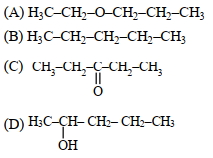
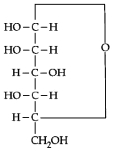
$(i)\,\, C_6H_5COCl$
The correct decreasing order of their reactivity towards hydrolysis is