Question
What pre-information would you require to convert a galvanometer into ammeter or voltmeter?
Answer

Two information’s are required:
  1. Resistance of galvanometer.
  2. Current in galvanometer for full scale deflection.

Need a full question paper?

Generate a complete, print-ready paper with questions like this in minutes — across 16+ boards, with answer keys.

Start Generating Free

Similar questions

Can we define the temperature of vacuum? The temperature of a single molecule?
Why does the bluish colour predominate in a clear sky?
When a semiconducting material is doped with an impurity, new acceptor levels are created. In a particular thermal collision, a valence electron receives an energy equal to 2kT and just reaches one of the acceptor levels. Assuming that the energy of the electron was at the top edge of the valence band and that the temperature T is equal to 300K, find the energy of the acceptor levels above the valence band.
When is a Wheatstone’s bridge most sensitive?
A laser light is focused by a converging lens. Will there be a significant chromatic aberration?
Suppose a charged particle moves with a velocity v near a wire carrying an electric current. A magnetic force, therefore, acts on it. If the same particle is seen from a frame moving with velocity v in the same direction, the charge will be found at rest. Will the magnetic force become zero in this frame? Will the magnetic field become zero in this frame?
The velocity of a particle is towards west at an instant. Its acceleration is not towards west, not towards east, not towards north and not towards south. Give an example of this type of motion.
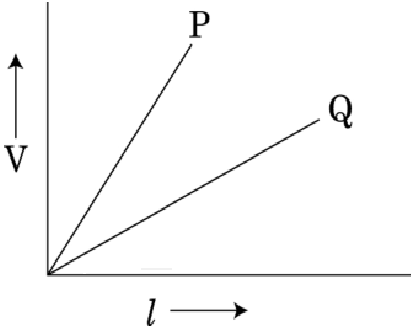
The variation of potential V with length l in case of two potentiometers wires P and Q is as shown. Which one of these will you prefer comparing emfs of two primary cells and why?

A steel wire of cross-sectional area 0.5mm2 is held between two fixed supports. If the wire is just taut at 20°C, determine the tension when the temperature falls to 0°C. Coefficient of linear expansion of steel is 1.2 × 10⁻⁵ °C-1 and its Young's modulus is 2.0 × 10¹¹N m-2.
In a calorimeter, the heat given by the hot object is assumed to be equal to the heat taken by the cold object. Does it mean that heat of the two objects taken together remaina constant?