Question
What should be do to get maximum benefit from a crop field?

Answer

To get the maximum benefit from a crop field, we should:
  1. Maintain the soil fertility through judicious use of manure and fertilizers.
  2. Practice crop rotation.
  3. Timely irrigation should be done at right time.
  4. Keep the weeds and insect pest population under control.

Need a full question paper?

Generate a complete, print-ready paper with questions like this in minutes — across 16+ boards, with answer keys.
Start Generating Free

Similar questions

There are four substances W, X, Y and Z. The substance W is a dark violet solid having diatomic molecules. A solution of W in alcohol is used as a common antiseptic C. The substance X is a white solid which is usually recovered from sea water on a large scale. The substance Y is a white solid which is insoluble in water and used in the form of small balls for the safe storage of woollen clothes. The substance Z is a yet another white solid which is used in making commonly used dry cells.
  1. Name (i) W (ii) X (iii) Y and (iv) Z.
  2. Out of W, X, Y and Z, which substance/ substances can undergo sublimation?
  3. Which substances organic in nature?
  4. What is the name of substance C?
  5. Which substance belongs to the halogen family?
What is artificial insemination? Give its uses.
What are the features and drawbacks of Rutherford’s nuclear model of an atom?

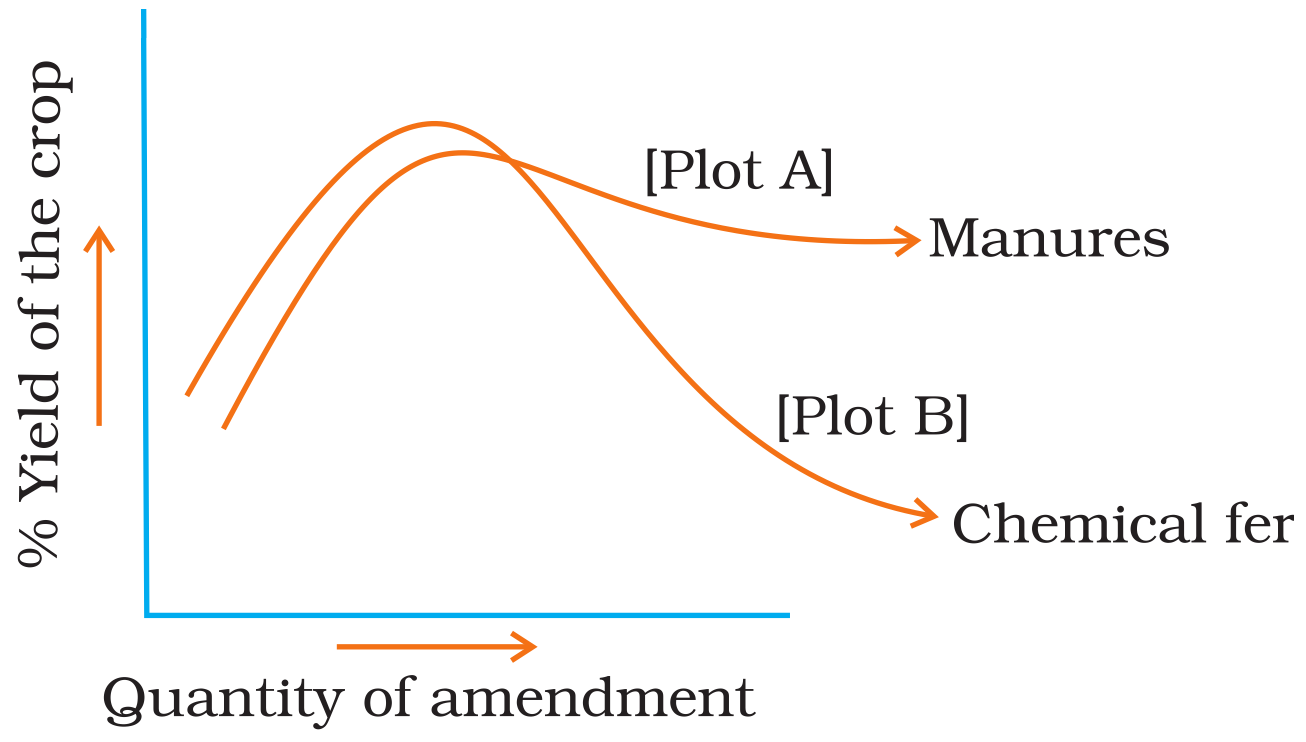
Figure shows the two crop fields [Plots A and B] have been treated by manures and chemical fertilizers respectively, keeping other environmental factors same. Observe the graph and answer the following questions.
  1. Why does plot B show sudden increase and then gradual decrease in yield?
  2. Why is the highest peak in plot A graph slightly delayed?
  3. What is the reason for the different pattern of the two graphs?
How will you separate common salt, sand and iron filings from their mixture?
Describe a simple experiment to show that the prongs of a sound producing tuning fork are vibrating.
Write the cations and anions present, if any, in the following:
  1. $CH_3COONa$
  2. $NaCl$
  3. $H_2$
  4. $NH_4NO_3$
What is feed? What are different type of feed? How is it differ with respect to age and functions?
Pragya tested the solubility of three different substances at different temperatures and collected the data as given below (results are given in the following table, as grams of substance dissolved in 100 grams of water to form a saturated solution).
Substance Dissolved  Temperature in K
283 293 313 333 353
Solubility
Potassium nitrate 21 32 62 106 167
Sodium chloride 36 36 36 37 37
Potassium chloride 35 35 40 46 54
Ammonium chloride 24 37 41 55
66
  1. What mass of potassium nitrate would be needed to produce a saturated solution of potassium nitrate in 50 grams of water at 313K?
  2. Pragya makes a saturated solution of potassium chloride in water at 353K and leaves the solution to cool at room temperature. What would she observe as the solution cools? Explain.
  3. Find the solubility of each salt at 293K. Which salt has the highest solubility at this temperature?
  4. What is the effect of change of temperature on the solubility of a salt?
Raunak took $5$ moles of carbon atoms in a container and Krish also took 5 moles of sodium atoms in another container of same weight.
$a.$ Whose container is heavier?
$b.$ Whose container has more number of atoms?