Question
What should be the distance between the object in Exercise 9.30 and the magnifying glass if the virtual image of each square in the figure is to have an area of $6.25\ mm^2$. Would you be able to see the squares distinctly with your eyes very close to the magnifier?
Answer

Area of the virtual image of each square, $A= 6.25\ mm^2$
Area of each square, $A_0= 1\ mm^2$​​​​​​​
Hence, the linear magnification of the object can be calculated as:
$\text{m}=\sqrt{\frac{\text{A}}{\text{A}_0}}$
$\text{m}=\sqrt{\frac{6.25}{1}}=2.5$
But, $\text{m}=\frac{\text{imagr dis tan ce(v)}}{\text{Object dis tan ce(u)}}$
$\therefore \ \text{v}=\text{mu}$
$= 2.5\ u ...(1)$
Focal length of the magnifying glass, f= 10 cm
According to the lens formula, we have the relation:
$\frac{1}{\text{f}}=\frac{1}{\text{v}}-\frac{1}{\text{u}}$
$\frac{1}{10}=\frac{1}{2.5\text{u}}-\frac{1}{\text{u}}=\frac{1}{\text{u}}\Big(\frac{1}{2.5}-\frac{1}{1}\Big)=\frac{1}{\text{u}}\Big(\frac{1-2.5}{2.5}\Big)$
$\therefore \ \text{u}=\frac{1.5\times10}{2.5}=-6 \ \text{cm}$
and v = 2.5 u
= 2.5 × 6 = -15 cm
The virtual image is formed at a distance of 15 cm, which is less than the near point (i.e., 25 cm) of a normal eye. Hence, it cannot be seen by the eyes distinctly.

Need a full question paper?

Generate a complete, print-ready paper with questions like this in minutes — across 16+ boards, with answer keys.

Start Generating Free

Similar questions

A capacitor of capacitance $10\mu\text{F}$ is connected across a battery of emf 6.0V through a resistance of $20\text{k}\Omega$ for 4.0s. The battery is then replaced by a thick wire. What will be the charge on the capacitor 4.0s after the battery is disconnected?
Derive an expression for the electric field intensity at a point on the equatorial line of an electric dipole of dipole moment $\overrightarrow{\text{P}}$and length 2a. What is the direction of this field?
  1. Three photo diodes $D_1, D_2$ and $D_3$ are made of semiconductors having band gaps of 2.5eV, 2eV and 3eV respectively. Which of them will not be able to detect light of wavelength 600nm?
  2. Why photodiodes are required to operate in reverse bias? Explain.
What is Motional electromotive force $(\text{emf})$ ? Obtain motional emf $(\varepsilon)= B I {v}$ using proper example.
For a normal eye, the far point is at infinity and the near point of distinct vision is about 25 cm in front of the eye. The cornea of the eye provides a converging power of about 40 dioptres, and the least converging power of the eye-lens behind the cornea is about 20 dioptres. From this rough data estimate the range of accommodation (i.e., the range of converging power of the eye-lens) of a normal eye.
A wire of length l carries a current i long the x-axis. A magnetic field exists, which is given $\overrightarrow{\text{B}}=\text{B}_0(\overrightarrow{\text{i}}+\overrightarrow{\text{j}}+\overrightarrow{\text{k}})\text{T}.$ Find the magnitude of the magnetic force acting on the wire.
The work function for a certain metal is 4.2 eV. Will this metal give photoelectric emission for incident radiation of wavelength 330 nm?
Answer the following:
  1. Name the em waves which are suitable for radar systems used in aircraft navigation- Write the range of frequency of these waves.
  2. If the earth did not have atmosphere, would its average surface temperature be higher or lower than what it is now? Explain.
  3. An em wave exerts pressure on the surface on which it is incident. Justify.
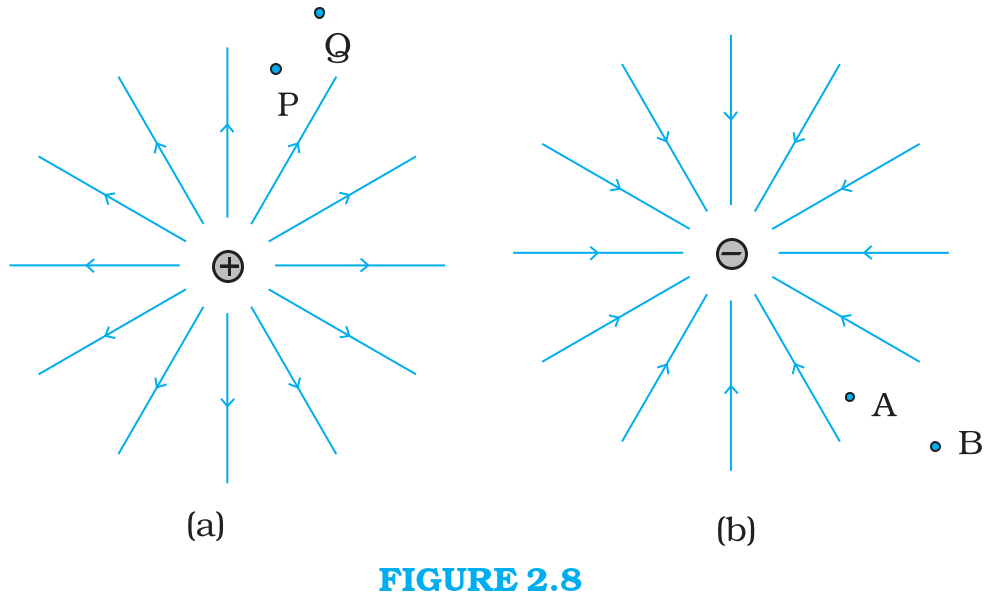
Figures 2.8 (a) and (b) show the field lines of a positive and negative point charge respectively.
Image
(a) Give the signs of the potential difference $V_{ P }-V_{ Q } ; V_{ B }-V_{ A }$.
(b) Give the sign of the potential energy difference of a small negative charge between the points $O$ and $P ; A$ and $B$.
(c) Give the sign of the work done by the field in moving a small positive charge from $Q$ to $P$.
(d) Give the sign of the work done by the external agency in moving a small negative charge from $B$ to $A$.
(e) Does the kinetic energy of a small negative charge increase or decrease in going from $B$ to $A$ ?
Answer the following questions:
  1. In a double slit experiment using light of wavelength 600 nm, the angular width of the fringe formed on a distant screen is $0.1^\circ$. Find the spacing between the two slits.
  2. Light of wavelength 5000 Å. Propagating in air gets partly reflected from the surface of water. How will the wavelengths and frequencies of the reflected and refracted light be affected?