Question
What type of wave front will emerge?
(i) From a point light source, (ii) From a remote light source.

Answer

(i) A spherical wave front will emerge from a point light source.
(ii) A flat wavefront will be obtained from a distant light source.

Need a full question paper?

Generate a complete, print-ready paper with questions like this in minutes — across 16+ boards, with answer keys.
Start Generating Free

Similar questions

Carbon, silicon and germanium have four valence electrons each. These are characterised by valence and conduction bands separated by energy band gap respectively equal to $ \left(E_g\right)_C, \left(E_g\right)_{S i}$ and $ \left(E_g\right)_{G e} $ Which of the following statements is true
A wheel with 10 metallic spokes each $0.5 m$ long is rotated with a speed of $120 rev / min$ in a plane normal to the horizontal component of earth's magnetic field $H_E$ at a place. If $H_E=0.4 G$ at the place, what is the induced emf between the axle and the rim of the wheel? Note that $1 G =10^{-4} T$.
The ratio of mass numbers of two nuclei is $1: 3$.
What is the ratio of their nuclear density?
Can a photon be deflected by an electric field? By a magnetic field?
What type of semiconductor will be obtained when pure Si crystal is doped with indium (In)?
A rectangular brick is kept on a table with a part of its length projecting out. It remains at rest if the length projected is slightly less than half the total length but it falls down if the length projected is slightly more than half the total length. Give reason.
Answer the following questions regarding earth’s magnetism:
Geologists claim that besides the main magnetic N-S poles, there are several local poles on the earth’s surface oriented in different directions. How is such a thing possible at all?
The nuclear radius of $^{27}_{13}\text{Al}$ is 3.6 fermi. Find the nuclear radius of $^{64}_{29}\text{Cu}.$
"Magnetic field lines form closed curves." Why?
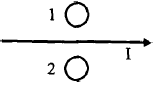
Predict the directions of induced currents in metal rings 1 and 2 lying in the same plane where current I in the wire is increasing steadily.