MCQ
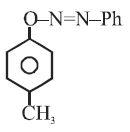
What will be product of reaction
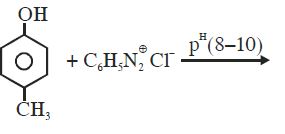
- ✓
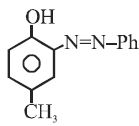
- B
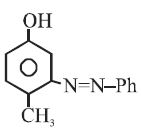
- C
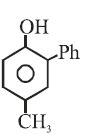
- D
Generate a complete, print-ready paper with questions like this in minutes — across 16+ boards, with answer keys.
$6 \mathrm{OH}^{-}+\mathrm{Cl}^{-} \rightarrow \mathrm{ClO}_{3}^{-}+3 \mathrm{H}_{2} \mathrm{O}+6 \mathrm{e}^{-}$
A current of $x A$ has to be passed for $10 h$ to produce $10.0 \mathrm{~g}$ of potassium chlorate. The value of $\mathrm{x}$ is $.......$ (Nearest integer)
(Molar mass of $\left.\mathrm{KClO}_{3}=122.6 \mathrm{~g} \mathrm{~mol}^{-1}, \mathrm{~F}=96500 \mathrm{C}\right)$
(image)
($A$) $R$ is steam volatile
($B$) $Q$ gives dark violet coloration with $1 \%$ aqueous $FeCl_3$ solution
($C$) $S$ gives yellow precipitate with $2, 4$-dinitrophenylhydrazine
($D$) $S$ gives dark violet coloration with $1 \%$ aqueous $FeCl_3$ solution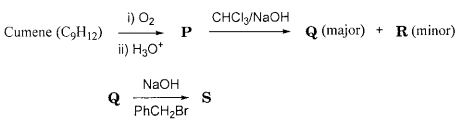
Assertion $(A)$ and the other is labeled as Reason $(R)$. Assertion $(A)$: $\mathrm{CH}_2=\mathrm{CH}-\mathrm{CH}_2-\mathrm{Cl}$ is an example of allyl halide
Reason$(R)$: Allyl halides are the compounds in which the halogen atom is attached to $\mathrm{sp}^2$ hybridised carbon atom.
In the light of the two above statements, choose the $most \ appropriate$ answer from the options given below: