MCQ
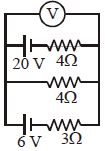
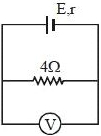
What will be reading of voltmeter ................. $V$
  • $8.4$
  • B
    $20$
  • C
    $6.2$
  • D
    $10.8$

Answer

Correct option: A.
$8.4$
a
From parallel combination of cell,

$\Rightarrow \mathrm{E}=\frac{\frac{20}{4}+\frac{6}{3}}{\frac{1}{4}+\frac{1}{3}}=12$ $\mathrm{volt}$ $\Rightarrow \mathrm{r}=\frac{12}{7}$

$\Rightarrow \mathrm{V}=4\left[\frac{12}{4+\frac{12}{7}}\right]=8.4 \mathrm{\,volt}$
Need a full question paper?

Generate a complete, print-ready paper with questions like this in minutes — across 16+ boards, with answer keys.
Start Generating Free

Similar questions

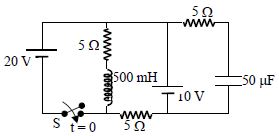
Switch $S$ is closed at $t = 0$, in the circuit shown. The change in flux in the inductor $(L=500\, mH)$ from $t = 0$ to an instant when it reaches steady state is ......$wb$
A beaker containing a liquid of density $\rho $ moves up with an acceleration $a$ ; the pressure due to the liquid at a depth $h$ below the free surface of the liquid is
The angular width of the central maximum in a single slit diffraction pattern is $60^o $ . The width of the slit is $1\ \mu m$. The slit is illuminated by monochromatic plane waves. If another slit of same width is made near it, Young's fringes can be observed on a screen placed at  distance $50\ cm$ from the slits. If the observed fringe width is $1\ cm$, what is slit separation distance?.........$\mu m$
(i.e. distance between the centres of each slit. )
The wavelength of $X-$ rays decreases, when
Among the two interfering monochromatic sources $A$ and $B$; $A$ is ahead of $B$ in phase by $66^o $. If the observation be taken from point $P$, such that $PB -PA = \lambda /4$. Then the phase difference between the waves from $A$ and $B$ reaching $P$ is.....$^o $
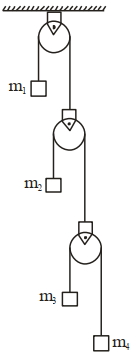
In the arrangement shown in figure $a _{1}, a _{2}, a _{3}$ and $a _{4}$ are the accelerations of masses $m _{1}, m _{2}, m _{3}$ and $m _{4}$ respectively. Which of the following relation is true for this arrangement?
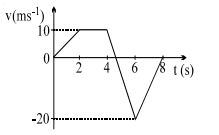
The figure shows a velocity-time graph of a particle moving along a straight line  The correct acceleration-time graph of the particle is shown as
A monochromatic point source of light is placed at a distance $d$ from a metal surface. Photo electrons are ejected at a rate $n$ per second, and with maximum kinetic energy $E$. If the source is brought nearer to distance $d / 2$, the rate and the maximum kinetic energy per photoelectron become nearly
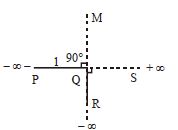
An infinitely long conductor $PQR$ is bent to from a right angle as shown. A current $I$ flows through $PQR$ . The magnetic field due to this current at the point $M$ is $H_1$ . Now, another infinitely long straight conductor $QS$ is connected at $Q$ so that the current in $PQ$ remaining unchanged. The magnetic field at $M$ is now $H_2$ . The ratio $H_1/H_2$ is given by
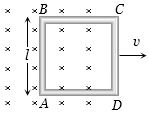
A conducting square loop of side $l$ and resistance $R$ moves in its plane with a uniform velocity $v$ perpendicular to one of its sides. A magnetic induction $B$ constant in time and space, pointing perpendicular and into the plane at the loop exists everywhere with half the loop outside the field, as shown in figure. The induced $e.m.f$. is