MCQ
What will be the acceleration due to gravity at height $h$ if $h >> R$. Where $R$ is radius of earth and $g$ is acceleration due to gravity on the surface of earth
  • $\frac{g}{{{{\left( {1 + \frac{h}{R}} \right)}^2}}}$
  • B
    $g\left( {1 - \frac{{2h}}{R}} \right)$
  • C
    $\frac{g}{{{{\left( {1 - \frac{h}{R}} \right)}^2}}}$
  • D
    $g\left( {1 - \frac{h}{R}} \right)$

Answer

Correct option: A.
$\frac{g}{{{{\left( {1 + \frac{h}{R}} \right)}^2}}}$
a
(a)$g' = g\,{\left( {\frac{R}{{R + h}}} \right)^2} = \frac{g}{{{{\left( {1 + \frac{h}{R}} \right)}^2}}}$

Need a full question paper?

Generate a complete, print-ready paper with questions like this in minutes — across 16+ boards, with answer keys.

Start Generating Free

Similar questions

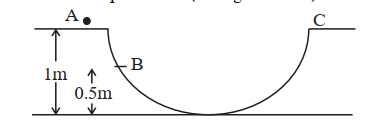
A particle is placed at the point $\mathrm{A}$ of a frictionless track $A B C$ as shown in figure. It is gently pushed toward right. The speed of the particle when it reaches the point $B$ is: $\left(\right.$ Take $g=10 \mathrm{~m} / \mathrm{s}^2$ ).
The height ${ }^{\prime} h ^{\prime}$ at which the weight of a body will be the same as that at the same depth $'h'$ from the surface of the earth is (Radius of the earth is $R$ and effect of the rotation of the earth is neglected):
The $SI$ unit of a physical quantity is pascal-second. The dimensional formula of this quantity will be ..............
Given below are two statements: one is labelled as Assertion $A$ and the other is labelled as Reason $R$.

Assertion $A$ : Body $'P'$ having mass $M$ moving with speed $'u'$ has head-on collision elastically with another body $'Q'$ having mass $'m'$ initially at rest. If $m< < M,$ body $'Q'$ will have a maximum speed equal to $'2u'$ after collision.

Reason $R$ : During elastic collision, the momentum and kinetic energy are both conserved.

In the light of the above statements, choose the most appropriate answer from the options given below:

Three containers $\mathrm{C}_{1}, \mathrm{C}_{2}$ and $\mathrm{C}_{3}$ have water at different temperatures. The table below shows the final temperature $T$ when different amounts of water (given in litres) are taken from each containers and mixed (assume no loss of heat during the process)

$\begin{array}{|c|c|c|c|}\hline \mathrm{C_{1 }} & {\mathrm{C}_{2}} & {\mathrm{C}_{3}} & {\mathrm{T}} \\ \hline {1 l} & {2 l} & {-} & {60^{\circ} \mathrm{C}} \\ \hline {-} & {1 l} & {2 l} & {30^{\circ} \mathrm{C}} \\ \hline  {2 l} & {-} & {1 l} & {60^{\circ} \mathrm{C}} \\ \hline  {1 l} & {1 l} & {1 l} & {\theta} \\ \hline\end{array}$

The value of $\theta$ (in $^{\circ} \mathrm{C}$ to the nearest integer) is

A balloon is at a height of $81\, m$ and is ascending upwards with a velocity of $12 \,m/s$. A body of $2\,kg$ weight is dropped from it. If $g = 10\,m/{s^2}$, the body will reach the surface of the earth in.........$s$
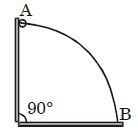
A wire, which passes through the hole in a small bead, is bent in the form of quarter of a circle. The wire is fixed vertically on ground as shown in the figure. The bead is released from near the top of the wire and it slides along the wire without friction. As the bead moves from $A$ to $B$, the force it applies on the wire is
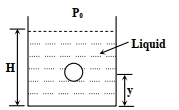
A small spherical monoatomic ideal gas bubble $\left(\gamma=\frac{5}{3}\right)$ is trapped inside a liquid of density $\rho_{\ell}$ (see figure). Assume that the bubble does not exchange any heat with the liquid. The bubble contains n moles of gas. The temperature of the gas when the bubble is at the bottom is $\mathrm{T}_0$, the height of the liquid is $\mathrm{H}$ and the atmospheric pressure is $\mathrm{P}_0$ (Neglect surface tension).

Figure: $Image$

$1.$ As the bubble moves upwards, besides the buoyancy force the following forces are acting on it

$(A)$ Only the force of gravity

$(B)$ The force due to gravity and the force due to the pressure of the liquid

$(C)$ The force due to gravity, the force due to the pressure of the liquid and the force due to viscosity of the liquid

$(D)$ The force due to gravity and the force due to viscosity of the liquid

$2.$ When the gas bubble is at a height $\mathrm{y}$ from the bottom, its temperature is

$(A)$ $\mathrm{T}_0\left(\frac{\mathrm{P}_0+\rho_0 \mathrm{gH}}{\mathrm{P}_0+\rho_t \mathrm{gy}}\right)^{2 / 5}$

$(B)$ $T_0\left(\frac{P_0+\rho_t g(H-y)}{P_0+\rho_t g H}\right)^{2 / 5}$

$(C)$ $\mathrm{T}_0\left(\frac{\mathrm{P}_0+\rho_t \mathrm{gH}}{\mathrm{P}_0+\rho_t \mathrm{gy}}\right)^{3 / 5}$

$(D)$ $T_0\left(\frac{P_0+\rho_t g(H-y)}{P_0+\rho_t g H}\right)^{3 / 5}$

$3.$ The buoyancy force acting on the gas bubble is (Assume $R$ is the universal gas constant)

$(A)$ $\rho_t \mathrm{nRgT}_0 \frac{\left(\mathrm{P}_0+\rho_t \mathrm{gH}\right)^{2 / 5}}{\left(\mathrm{P}_0+\rho_t \mathrm{gy}\right)^{7 / 5}}$

$(B)$ $\frac{\rho_{\ell} \mathrm{nRgT}_0}{\left(\mathrm{P}_0+\rho_{\ell} \mathrm{gH}\right)^{2 / 5}\left[\mathrm{P}_0+\rho_{\ell} \mathrm{g}(\mathrm{H}-\mathrm{y})\right]^{3 / 5}}$

$(C)$ $\rho_t \mathrm{nRgT} \frac{\left(\mathrm{P}_0+\rho_t g \mathrm{H}\right)^{3 / 5}}{\left(\mathrm{P}_0+\rho_t g \mathrm{~g}\right)^{8 / 5}}$

$(D)$ $\frac{\rho_{\ell} \mathrm{nRgT}_0}{\left(\mathrm{P}_0+\rho_{\ell} \mathrm{gH}\right)^{3 / 5}\left[\mathrm{P}_0+\rho_t \mathrm{~g}(\mathrm{H}-\mathrm{y})\right]^{2 / 5}}$

Give the answer question $1,2,$ and $3.$
A horizontal curve on $a$ racing track is banked at a $45^o $ angle. When a vehicle goes around this curve at the curve’s safe speed (no friction needed to stay on the track), what is its centripetal acceleration?
A ball is moving uniformly in a circular path of radius $1 m$ with a time period of $1.5 \,s$. If the ball is suddenly stopped at $t=8.3 \,s$, the magnitude of the displacement of the ball with respect to its position at $t=0 \,s$ is closest to .......... $m$