MCQ
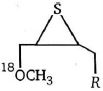
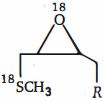
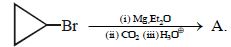
What will be the final major product ?
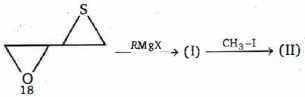
  • A

  • B


  • D

Answer

Correct option: C.

c
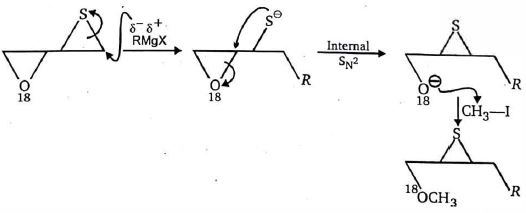
Ring containing sulphur is more strained.

Need a full question paper?

Generate a complete, print-ready paper with questions like this in minutes — across 16+ boards, with answer keys.
Start Generating Free

Similar questions

$'A'$ is
Given below are two statements:

Statement $I$: The boiling point of hydrides of Group $16$ elements follow the order

$\mathrm{H}_2 \mathrm{O}>\mathrm{H}_2 \mathrm{Te}>\mathrm{H}_2 \mathrm{Se}>\mathrm{H}_2 \mathrm{~S}$.

Statement $II$: On the basis of molecular mass, $\mathrm{H}_2 \mathrm{O}$ is expected to have lower boiling point than the othe members of the group but due to the presence of extensive $\mathrm{H}$-bonding in $\mathrm{H}_2 \mathrm{O}$, it has higher boiling point.

In the light of the above statements, choose the correct answer from the options given below:

For the reaction:

$RCH _2 Br + I ^{-} \stackrel{\text { Acetone }}{\longrightarrow} \underset{\text { major }}{ RCH _2 I + Br ^{-}}$

The correct statement is :

The ratio of the molar amounts of ${H_2}S$ needed to precipitate the metal ions from $20\,mL$ each of $1\,M\;Cd{(N{O_3})_2}$ and $0.5\,M\;CuS{O_4}$ is
Amongst $FeCl _{3} \cdot 3 H _{2} O , \quad K _{3}\left[ Fe ( CN )_{6}\right]$ and $\left[ Co \left( NH _{3}\right)_{6}\right] Cl _{3}$, the spin-only magnetic moment value of the inner-orbital complex that absorbs light at shortest wavelength is $B.M.\,......$ [nearest integer]
Assertion : $4-$ Nitrochlorobenzene undergoes nucleophilic substitution more readily than chlorobenzene.
Reason : Chlorobenzene undergoes nucleophilic substitution by elimination-addition mechanism while $4-$ nitrochlorobenzene undergoes nucleophilic substitution by addition-elimination mechanism.
Consider the following reaction

${C_6}{H_6}(l)\, + \,\frac{{15}}{2}\,{O_2}(g)\, \to \,6\,C{O_2}(g)\, + \,3{H_2}O\,(g)$

Signs of $\Delta H,\,\Delta S$ and $\Delta G$ for the above reaction will be

Given
$
\begin{array}{l}
C_{\text {graphite }}+O_2 \rightarrow CO_2(g): \\
\Delta_{r} H^0=-393.5 KJ / mol
\end{array}
$
$
H_2(g)+\frac{1}{2} O_2(g) \rightarrow H_2 O(l)
$
$
\Delta_r H^0=-285.8 kJ / mol
$
$
CO_2(g)+2 H_2 O(l) \rightarrow CH_4(g)+2 O_2(g):
$
$
\Delta_r H^0=+890.3 kJ mol^{-1}
$
Based on the above thermochemical equations, the value of $\Delta_r H^0$ at 298 K for the reaction
$
C_{\text {(graphite) }}+2 H_2(g) \rightarrow CH_4(g) \text { will be : }
$
$C{H_3} - C{H_2} - Cl $  $ \xrightarrow{alcKOH} $ $A$, the product is
Cylohexene $image$  is __________type of an organic compound.