Question
What will be the path difference between two light waves $y_1=a_1 \sin \omega t$ and $y_2=a_2 \cos (\omega t+$ $\phi)$ ?

Answer

Equation of first wave
$y_1=a_1 \sin \omega t$
Equation of second wave
$y_2=a_2 \cos (\omega t+\phi)$
or $y_2=\sin \left(\omega t+\phi+\frac{\pi}{2}\right)$
Phase difference between first and second wave
$\Delta \phi=\phi_2-\phi_1$
$=\left(\omega t+\phi+\frac{\pi}{2}\right)-\omega t$
or $\Delta \phi=\phi+\frac{\pi}{2}$
Phase difference due to path difference
$\Delta \phi=\frac{2 \pi}{\lambda} \times \Delta x$
Path difference
$\Delta x=\frac{\Delta \phi \times \lambda}{2 \lambda}$
$\therefore$ For given waves $I^{\text {st }}$ and $2^{\text {nd }}$, the path difference
$\Delta x=\frac{\lambda}{2 \pi}\left(\phi+\frac{\pi}{2}\right)$ $\qquad Ans. $

Need a full question paper?

Generate a complete, print-ready paper with questions like this in minutes — across 16+ boards, with answer keys.
Start Generating Free

Similar questions

A gravitational lens may be assumed to have a varying width of the form
$\text{w}(\text{b})=\text{k}_1\text{ In }\Big(\frac{\text{k}_2}{\text{b}}\Big)\ \ \text{b}_\text{min}<\text{b}<\text{b}_\text{max}$
$=\text{k}_1\text{ In }\Big(\frac{\text{k}_2}{\text{b}_\text{min}}\Big)\ \ \text{b}<\text{b}_\text{min}$
Show that an observer will see an image of a point object as a ring about the center of the lens with an angular radius
$\beta=\sqrt{\frac{(\text{n}-1)\text{k}_1\frac{\text{u}}{\text{v}}}{\text{u}+\text{v}}}$
Find the charge required to flow through an electrolyte to liberate one atom of.
  1. A monovalent material.
  2. A divalent material.
The magnetic field B and the magnetic intensity H in material are found to be 1.6T and 1000A/m reepectively. Calculate the relative permeability $\mu_\text{r}$ and the susceptibility x of the material.
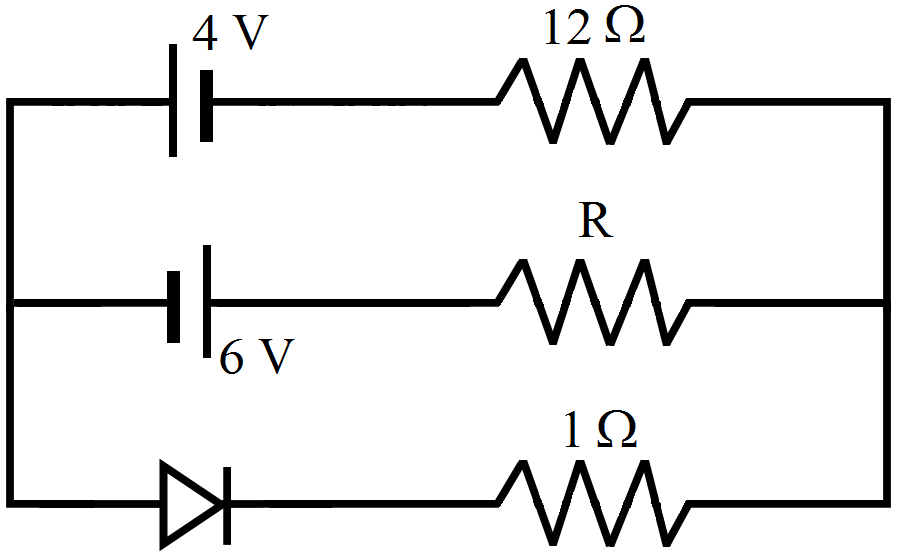
Find the current through the resistance R in figure. if.

  1. $\text{R}=12\Omega$
  2. $\text{R}=48\Omega$
Can $\text{L}_\alpha$ X-ray of one material have shorter wavelength than $\text{K}_\alpha$ X-ray of another?
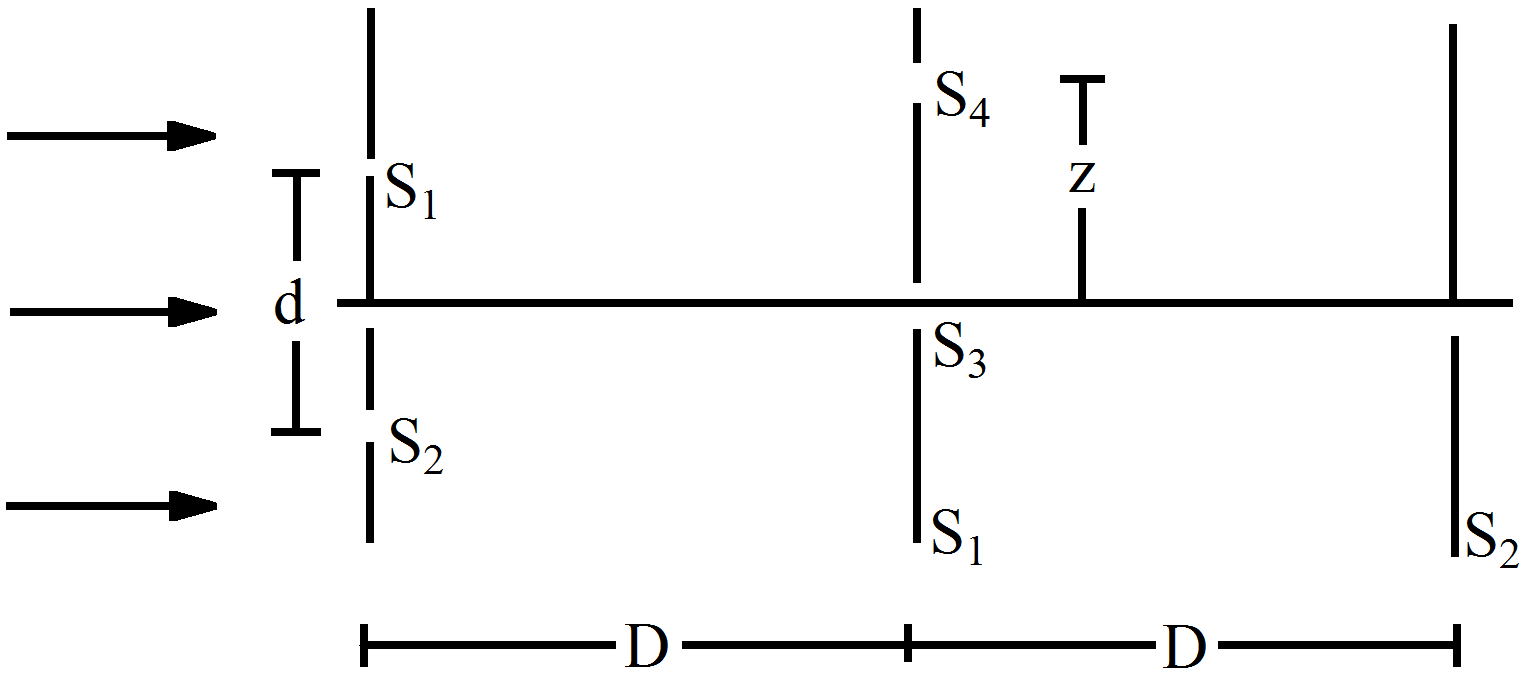
Consider the situation shown in figure (17-E6). The two slits S1 and S2 p laced symmetrically around the central line are illuminated by a monochromatic light of wavelength $\lambda.$ The separation between the slits is d. The light transmitted by the slits falls on a screen E1 placed at a distance D from the slits. The slit S3 is at the central line and the slit S4 is at a distance z from S3. Another

screen $\sum_2$ is placed a further distance D away from $\sum_1$. Find the ratio of the maximum to minimum intensity observed on $\sum_2$, if z is equal to,

  1. $\text{z}=\frac{\lambda\text{D}}{2\text{d}}$

  2. $\frac{\lambda\text{D}}{\text{d}}$

  3. $\frac{\lambda\text{D}}{4\text{d}}$
A proton projected in a magnetic field of 0.020T travels along a helical path of radius 5.0cm and pitch 20cm. Find the components of the velocity of the proton along and perpendicular to the magnetic field. Take the mass of the proton = 1.6 × 10⁻²⁷kg
A parallel-plate capacitor of plate area 40cm2 and separation between the plates 0.10mm, is connected to a battery of emf 2.0V through a $16\Omega$ resistor. Find the electric field in the capacitor 10ns after the connections are made.
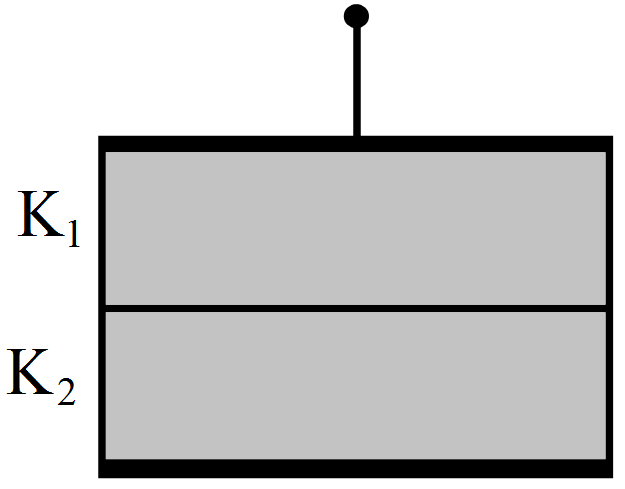
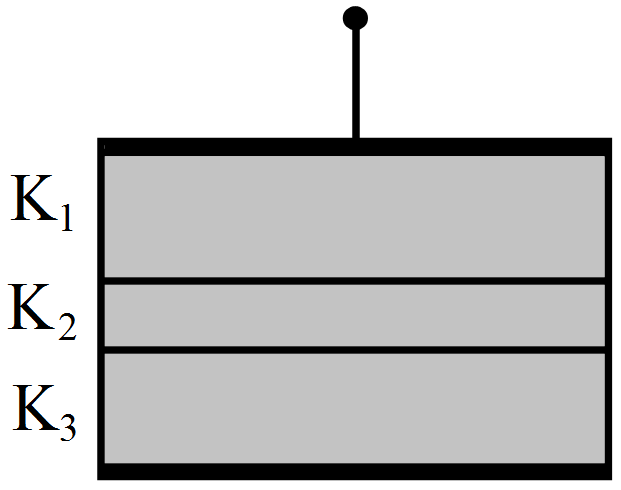
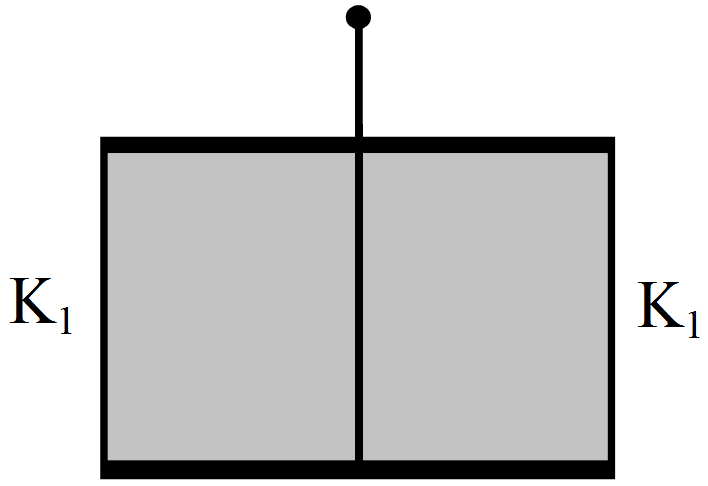
Find the capacitances of the capacitors shown in figure. The plate area is A and the separation between the plates is d. Different dielectric slabs in a particular part of the figure are of the same thickness and the entire gap between the plates is filled with the dielectric slabs.


A beam of white light is incident normally on a plane surface absorbing 70% of the light and reflecting the rest. If the incident beam carries 10W of power, find the force exerted by it on the surface.