Question
What would be an effect on equilibrium price and quantity when demand and supply both increase at the same rate?
OR
Explain with the help of a diagram a situation when demand and supply curves shift to the right but equilibrium price remains the same.
OR
Market for a good is in equilibrium. What is the effect on equilibrium price and quantity if both the market demand and the market supply of the goods increase in the same proportion? Use diagram.
Answer

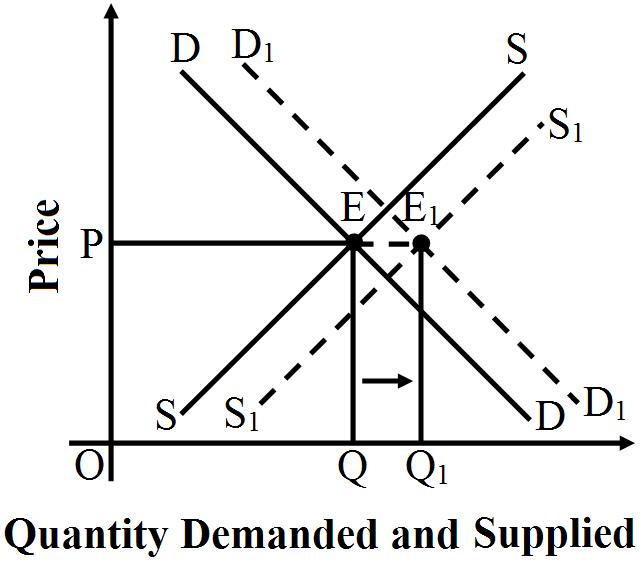
When demand and supply both increase at the same rate, equilibrium price remains constant and equilibrium quantity rises. It can be shown with the help of the following diagram.

In the above diagram price is measured on vertical axis and quantity demanded and supplied is measured on horizontal axis. Initially, the equilibrium price is $OP$ and equilibrium quantity is $OQ$. But as given in the examination problem, "demand and supply both increase at the same rate", then,
  1. Equilibrium price remains constant at $OP$.
  2. Equilibrium quantity rises from $OQ$ to $OQ_1$

Need a full question paper?

Generate a complete, print-ready paper with questions like this in minutes — across 16+ boards, with answer keys.

Start Generating Free

Similar questions

Explain any three determinants of demand for commodity.
A firm fixed average cost of producing 2 units of a good is Rs.9 and its total cost schedule is given below. Calculate average variable cost and marginal cost for each of given level of output.
Output (Units)
1
2
3
Total Cost (₹)
23
27
30
“Scarcity and choice go all together". Defend or refute. (3-4 Marks).
At a price of $5$ per unit of a commodity A, Total Revenue is ₹ $800$. When its price rises by $20\%$, Total Revenue increases by ₹ $400.$ Calculate its Price Elasticity of Supply.
Why does an economic problem arise?OR
State any two causes of economic problem.
OR
State two characteristics of the economic resources which give rise to economic problem.
OR
Why does problem of choice arise?
OR
Explain three factors that lead to an economic problem.
There are no barriers in the way of firms leaving or joining industry in a perfectly competitive market. Explain the significance of this feature.
What is the value of the MR when the demand curve is elastic?
Define cost. State the relation between marginal cost. and average variable cost.
Under perfect competition, MR = AR, but under monopoly, MR < AR. Explain.
China is a big manufacturer of telephone instruments. It has recently become a member of $WTO$, which means that it can sell its product in other member countries like India. Suppose that it does export a large number of telephone instruments to India.
  1. How will it affect the price and quantity sold of telephone instruments in India?
  2. Suppose that the demand for telephone instruments is relatively elastic. How will it affect India's total expenditure on telephone instruments?