Question
When $1.0 \times 10^{12}$ electrons are transferred from one conductor to another, a potential difference of 10V appears between the conductors. Calculate the capacitance of the two-conductor system.

Answer

Given that Number of electron = $1 \times 10^{12}$ Net charge $Q = 1 \times 10^{12} \times 1.6 \times 10^{-19} = 1.6 \times 10^{-7}C$ $\therefore$ The net potential difference = 10L.
$\therefore$ Capacitance $\text{C}=\frac{\text{q}}{\text{v}}$
$=\frac{1.6\times10^{-7}}{10}=1.6\times10^{-8}\text{F}.$

Need a full question paper?

Generate a complete, print-ready paper with questions like this in minutes — across 16+ boards, with answer keys.
Start Generating Free

Similar questions

Explain this common observation clearly: If you look out of the window of a fast moving train, the nearby trees, houses etc. seem to move rapidly in a direction opposite to the train’s motion, but the distant objects (hill tops, the Moon, the stars etc.) seem to be stationary. (In fact, since you are aware that you are moving, these distant objects seem to move with you).
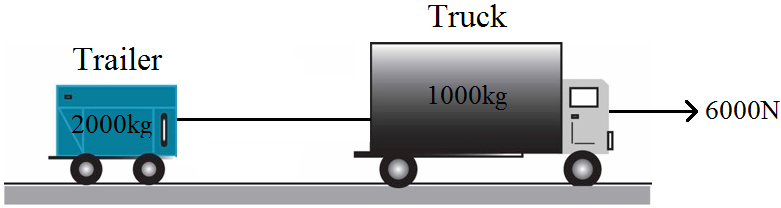
A truck of mass $1000\ kg$ is pulling a trailer of mass $2000\ kg$ as shown. The retarding $($frictional$)$ force on the truck is $500N$ and that on the trailer is $1000N$. The truck engine exerts a force of $6000N$. Calculate:
  1. The acceleration of the truck and the trailer.
  2. The tension in the connecting rope.
To maintain a rotor at a uniform angular speed of $200rad s^{-1}$, an engine needs to transmit a torque of 180Nm. What is the power required by the engine? (Note: uniform angular velocity in the absence of friction implies zero torque. In practice, applied torque is needed to counter frictional torque). Assume that the engine is 100% efficient.
A constant retarding force of $50N$ is applied to a body of mass $20kg$ moving initially with a speed of $15ms^{-1}$. How long does the body take to stop?
A cricket ball of mass $150g$ is moving with a velocity of $12ms^{-1}$, and is hit by a bat, so that the ball is turned back with a velocity of $20ms^{-1}​​​​​​​$. The force of the blow acts for $0.01s$ on the ball. Find the average force exerted by the bat on the ball.
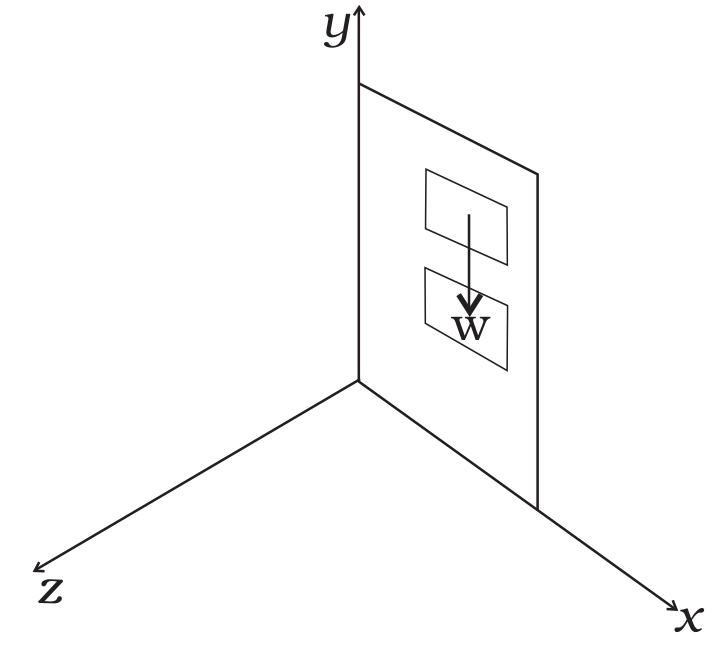
A door is hinged at one end and is free to rotate about a vertical axis. Does its weight cause any torque about this axis? Give reason for your answer.
A wheel of moment of inertia $0.10kg-m^2$ is rotating about a shaft at an angular speed of $160rev/ minute$. A second wheel is set into rotation at $300rev/ minute$ and is coupled to the same shaft so that both the wheels finally rotate with a common angular speed of $200rev/ minute$. Find the moment of inertia of the second wheel.
A force of 6.4N stretches a vertical spring by 0.1m. Find the mass that must be suspended from the spring so that it oscillates with the period of $\Big(\frac{\pi}{4}\Big)$ second.
Find the angular velocity of a body rotating with an acceleration of $2 \mathrm{rev} / \mathrm{s}^2$ as it completes the $5^{\text {th }}$ revolution after the start.
A molecule in a gas container hits a horizontal wall with speed $200ms^{-1}$ and angle 30° with the normal, and rebounds with the same speed. Is momentum conserved in the collision? Is the collision elastic or inelastic?