Question
When 1.0 × 10¹² electrons are transferred from one conductor to another, a potential difference of 10V appears between the conductors. Calculate the capacitance of the two-conductor system.

Answer

Given that

Number of electron = 1 × 10¹²

Net charge Q = 1 × 1012 × 1.6 × 10-19 = 1.6 × 10⁻⁷C

$\therefore$ The net potential difference = 10L.

$\therefore$ Capacitance

$\text{C}=\frac{\text{q}}{\text{v}}$

$=\frac{1.6\times10^{-7}}{10}=1.6\times10^{-8}\text{F}.$

Need a full question paper?

Generate a complete, print-ready paper with questions like this in minutes — across 16+ boards, with answer keys.
Start Generating Free

Similar questions

In a single slit diffraction experiment, a slit of width d is illuminated by red light of wavelength 650 nm. For what value of d will
i. the first minimum fall is at an angle of diffraction of 30°and
ii. the first maximum fall is at an angle of diffraction of 30°?
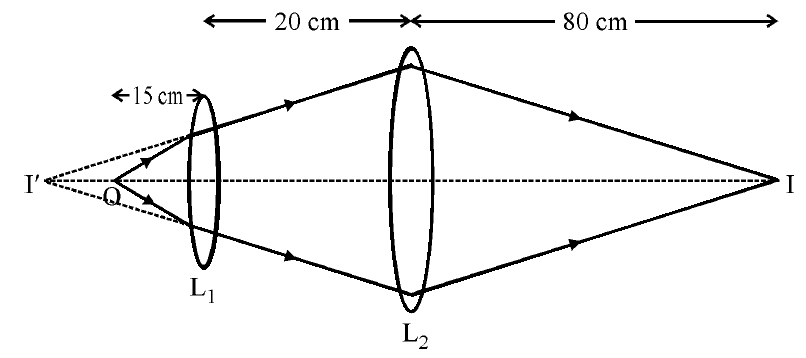
In the following diagram, an object ‘O’ is placed 15 cm in front of a convex lens L1 of focal length 20 cm and the final image is formed at ‘I’ at a distance of 80 cm from the second lens L2. Find the focal length of the lens L2.

Identify the following electromagnetic radiations as per the frequencies given below:
  1. 1020Hz
  2. 109Hz
  3. 1011Hz
Write one application of each.
Two insulating small spheres are rubbed against each other and placed 1cm apart. If they attract each other with a force of 0.1N, how many electrons were transferred from one sphere to the other dunng rubbing?
  1. Define self-inductance. Write its SI units.
  2. A long solenoid with 15 turns per cm has a small loop of area 2.0 cm2 placed inside the solenoid normal to its axis. If the current carried by the solenoid changes steadily from 2.0 A to 4.0 A in 0.1 s, what is the induced emf in the loop while the current is changing?
Two charges 2 $\mu C$ and - 2$\mu C$ are placed at points A and B 6 cm apart.
(a) Identify an equipotential surface of the system.
(b) What is the direction of the electric field at every point on this surface?
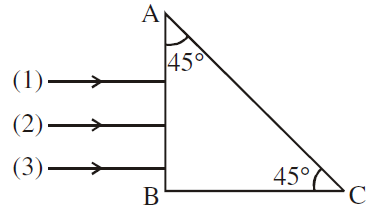
Three rays (1, 2, 3) of different colours fall normally on one of the sides of an isosceles right angled prism as shown. The refractive index of prism for these rays is 1.39, 1.47 and 1.52 respectively. Find which of these rays get internally reflected and which get only refracted from AC. Trace the paths of rays. Justify your answer with the help of necessary calculations.

Consider the plane S formed by the dipole axis and the axis of earth. Let P be point on the magnetic equator and in S. Let Q be the point of intersection of the geographical and magnetic equators. Obtain the declination and dip angles at P and Q.
A flywheel of moment of inertia 5.0kg-m2 is rotated at a speed of 60rad/s. Because of the friction at the axle, it comes to rest in 5.0 minutes. Find:
  1. The average torque of the friction.
  2. The total work done by the friction.
  3. The angular momentum of the wheel 1 minute before it stops rotating.
In an accelerator experiment on high-energy collisions of electrons with positrons, a certain event is interpreted as annihilation of an electron-positron pair of total energy 10.2 BeV into two γ-rays of equal energy. What is the wavelength associated with each γ-ray? (1BeV = 109 eV).