Question

When a bar magnet falls through a long hollow metal cylinder fixed with its axis vertical, the final acceleration of the magnet is

(a) Equal to zero

(b) Less than g

(c) Equal to g

(d) Equal to g in to beginning and then more than g

Answer

(a) Equal to zero

Need a full question paper?

Generate a complete, print-ready paper with questions like this in minutes — across 16+ boards, with answer keys.

Start Generating Free

Similar questions

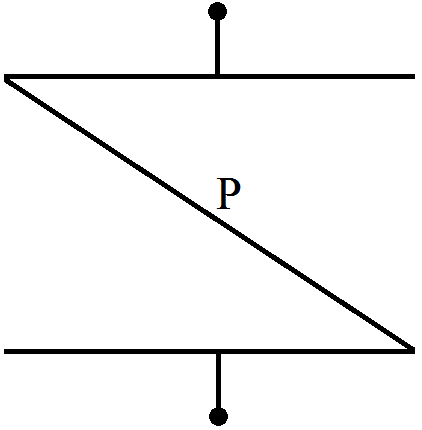
A thin metal plate P is inserted between the plates of a parallel-plate capacitor of capacitance C in such a way that its edges touch the two plates (figure). The capacitance now becomes:

  1. $\frac{\text{C}}{2}$
  2. 2C
  3. 0
  4. Indeterminate.

An oxide coated filament is useful in vacuum tubes because essentially

(a) It has high melting point

(b) It can withstand high temperatures

(c) It has good machanical strength

(d) It can emit electrons at relatively lower temperatures

When a capillary tube is dipped into a liquid, the liquid neither rises nor falls in the capillary.
  1. The surface tension of the liquid must be zero.
  2. The contact angle must be 90º.
  3. The surface tension may be zero.
  4. The contact angle may be 90°.
The value of current obtained in a moving coil galvanometer is proportional to :
The gate for which output is high if atleast one input is low?
The interior of a conductor can have no excess ____ in the static situation.

In a hydrogen atom, an electron moves in a circular orbit of radius 5.2   and produces a magnetic induction of 12.56 T at its nucleus. The current produced by the motion of the electron will be (Given  

(a) 6.53  

(b) 13.25  

(c) 9.6   

(d) 1.04   

 Which radiations will be most effective for the emission of electrons from a metallic surface?

A radioactive nucleus with Z protons and N neutrons emits an a-particle, 2b-particles and 2 gamma rays. The number of protons and neutrons in the nucleus left after the decay respectively, are

(a) Z – 3, N – 1

(b) Z – 2, N – 2

(c) Z – 1, N – 3

(d) Z, N – 4

The kinetic energy of an electron revolving around a nucleus will be

(a) Four times of P.E.

(b) Double of P.E.

(c) Equal to P.E.

(d) Half of its P.E.