MCQ
When a body is placed on a rough plane inclined at an angle $\theta $ to the horizontal, its acceleration is
  • A
    $g(\sin \theta - \cos \theta )$
  • $g(\sin \theta + \mu \cos \theta )$
  • C
    $g(\mu \sin \theta  - \cos \theta )$
  • D
    $g\mu (\sin \theta - \cos \theta )$

Answer

Correct option: B.
$g(\sin \theta + \mu \cos \theta )$
b
$F_{\min }=M g \sin \theta+\mu m g \cos \theta=m g(\sin \theta+\mu \cos \theta)$

Therefore acceleration is given by

$A=g(\sin \theta+\mu \cos \theta)$

Need a full question paper?

Generate a complete, print-ready paper with questions like this in minutes — across 16+ boards, with answer keys.

Start Generating Free

Similar questions

Water rises to a height of $10$ cm in capillary tube and mercury falls to a depth of $3.112$ cm in the same capillary tube. If the density of mercury is $13.6$ and the angle of contact for mercury is $135^o $, the ratio of surface tension of water and mercury is
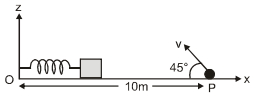
A small block is connected to one end of a massless spring of un-stretched length $4.9 \ m$. The other end of the spring (see the figure) is fixed. The system lies on a horizontal frictionless surface. The block is stretched by $0.2$ $m$ and released from rest at $t =0$. It then executes simple harmonic motion with angular frequency $\omega=\frac{\pi}{3} \ rad / s$.

Simultaneously at $t=0$, a small pebble is projected with speed $v$ from point $P$ at an angle of $45^{\circ}$ as shown in the figure. Point $P$ is at a horizontal distance of $10 \ cm$ from $O$. If the pebble hits the block at $t=1 \ s$, the value of $v$ is (take $g =10 \ m / s ^2$ )

When a block of mass $M$ is suspended by a long wire of length $L$, the length of the wire become $(L+l) .$ The elastic potential energy stoped in the extended wire is :
If $\overrightarrow {\rm A} = 2\hat i + 3\hat j - \hat k$ and $\overrightarrow B = - \hat i + 3\hat j + 4\hat k$ a unit vector perpendicular to both $\overrightarrow A $ and $\overrightarrow B $ will be
A simple pendulum hangs from the ceiling of a car. If the car accelerates with a uniform acceleration, the frequency of the simple pendulum will
An object may have:
$i.$ varying speed without having varying velocity.
$ii.$ varying velocity without having varying speed.
$iii.$ non-zero acceleration without having varying velocity.
$iv.$ non-zero acceleration without having varying speed.
A bob of mass $m$ attached to an inextensible string of length $l$ is suspended from a vertical support. The bob rotates in a horizontal circle with an angular speed $\omega\ rad/s$ about the vertical. About the point of suspension:
A body of mass $60 g$ experiences a gravitational force of $3.0 N$, when placed at a particular point. The magnitude of the gravitational field intensity at that point is ..... $N/ kg$
A car goes around uniform circular track of radius $R$ at a uniform speed $v$ once in every $T$ seconds. The magnitude of the centripetal acceleration is $a_c$. If the car now goes uniformly around a larger circular track of radius $2 R$ and experiences a centripetal acceleration of magnitude $8 a_c$. Then, its time period is
Orbital velocity of an artificial satellite does not depend upon