MCQ
When a body is stationary
  • A
    There is no force acting on it
  • B
    The force acting on it is not in contact with it
  • The combination of forces acting on it balances each other
  • D
    The body is in vacuum

Answer

Correct option: C.
The combination of forces acting on it balances each other
c
(c)

Need a full question paper?

Generate a complete, print-ready paper with questions like this in minutes — across 16+ boards, with answer keys.
Start Generating Free

Similar questions

A simple pendulum is hanging from a peg inserted in a vertical wall. Its bob is stretched in horizontal position from the wall and is left free to move. The bob hits on the wall the coefficient of restitution is $\frac{2}{{\sqrt 5 }}$. After how many collisions the amplitude of vibration will become less than $60°$
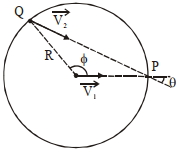
Two particles, one at the centre of a circle of radius $R$, and another at a point $Q$ on the circle, start moving towards a point $P$ on the circle at the same time (see figure below). Both are at rest initially and move with uniform velocities $\vec{V}_1$ and $\overrightarrow{V_2}$ respectively. They also reach the point $P$ at the same time, If the angle between the velocities is $\theta$ and the angle subtended by $P$ and $Q$ at the centre is $\phi$ (as shown in the figure), then
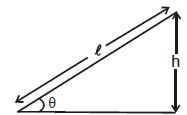
A smooth inclined plane is inclined at an angle $\theta$ with horizontal. A body starts from rest and slides down the inclined surface. Then the time taken by it to reach the bottom is
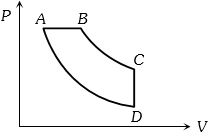
In pressure-volume diagram given below, the isochoric, isothermal, and isobaric parts respectively, are
A particle executing simple harmonic motion with amplitude of $0.1 \,m$. At a certain instant when its displacement is $0.02 \,m$, its acceleration is $0.5 \,m/s^2$. The maximum velocity of the particle is (in $m/s$)
A mass $\mathrm{m}$ is suspended from a spring of negligible mass and the system oscillates with a frequency $f_1$. The frequency of oscillations if a mass $9 \mathrm{~m}$ is suspended from the same spring is $f_2$. The value of $\frac{f_1}{f_{.2}}$ is_____________.
One mole of ideal gas required 207J heat to rise the temperature by 10°K when heated at constant pressure. If the same gas is heated at constant volume to raise the temperature by the same 10°K the heat required is (R = 8/ 3J/ mole°K)
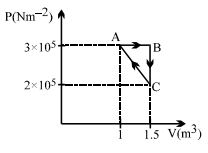
Considere the thermodynamics cycle shown on $PV$ diagram. The process $A \rightarrow B$ is isobaric, $B \rightarrow C$ is isochoric and $C \rightarrow A$ is a straight line process. The following internal energy and heat are given $: \Delta U_{A \rightarrow B} = + 400\,\, kJ$ and $Q_{B \rightarrow C} = - 500\,\, kJ$ The heat flow in the process $Q_{C \rightarrow A}$ is  ...... $kJ$
$Assertion$ : Mountain roads rarely go straight up the slope.
$Reason$ : Slope of mountains are large, therefore more chances of vehicle to slip from roads
The stationary wave produced on a string is represented by the equation $y = 5\cos (\pi x/3)\sin 40\pi \,t$. Where $x$ and $y$ are in cm and $t$ is in seconds. The distance between consecutive nodes is .... $cm$